


Page 718 - Textbook of Pathology, 6th Edition
P. 718
702


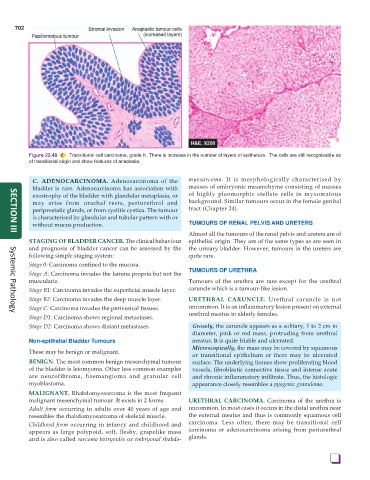
           Figure 22.48  Transitional cell carcinoma, grade II. There is increase in the number of layers of epithelium.  The cells are still recognisable as
           of transitional origin and show features of anaplasia.


            C. ADENOCARCINOMA. Adenocarcinoma of the           myosarcoma.  It is morphologically characterised by
            bladder is rare. Adenocarcinoma has association with  masses of embryonic mesenchyme consisting of masses
            exostrophy of the bladder with glandular metaplasia, or  of highly pleomorphic stellate cells in myxomatous
            may arise from urachal rests, periurethral and     background. Similar tumours occur in the female genital
            periprostatic glands, or from cystitis cystica. The tumour  tract (Chapter 24).
            is characterised by glandular and tubular pattern with or
            without mucus production.                          TUMOURS OF RENAL PELVIS AND URETERS
                                                               Almost all the tumours of the renal pelvis and ureters are of
     SECTION III
           STAGING OF BLADDER CANCER. The clinical behaviour   epithelial origin. They are of the same types as are seen in
           and prognosis of bladder cancer can be assessed by the  the urinary bladder. However, tumours in the ureters are
           following simple staging system:                    quite rare.
           Stage 0: Carcinoma confined to the mucosa.
                                                               TUMOURS OF URETHRA
           Stage A: Carcinoma invades the lamina propria but not the
           muscularis.                                         Tumours of the urethra are rare except for the urethral
           Stage B1: Carcinoma invades the superficial muscle layer.  caruncle which is a tumour-like lesion.
           Stage B2: Carcinoma invades the deep muscle layer.  URETHRAL CARUNCLE.  Urethral caruncle is not
           Stage C: Carcinoma invades the perivesical tissues.  uncommon. It is an inflammatory lesion present on external
                                                               urethral meatus in elderly females.
     Systemic Pathology
           Stage D1: Carcinoma shows regional metastases.
           Stage D2: Carcinoma shows distant metastases.         Grossly, the caruncle appears as a solitary, 1 to 2 cm in
                                                                 diameter, pink or red mass, protruding from urethral
           Non-epithelial Bladder Tumours                        meatus. It is quite friable and ulcerated.
                                                                 Microscopically, the mass may be covered by squamous
           These may be benign or malignant.
                                                                 or transitional epithelium or there may be ulcerated
           BENIGN. The most common benign mesenchymal tumour     surface. The underlying tissues show proliferating blood
           of the bladder is leiomyoma. Other less common examples  vessels, fibroblastic connective tissue and intense acute
           are neurofibroma, haemangioma and granular cell       and chronic inflammatory infiltrate. Thus, the histologic
           myoblastoma.                                          appearance closely resembles a pyogenic granuloma.
           MALIGNANT. Rhabdomyosarcoma is the most frequent
           malignant mesenchymal tumour. It exists in 2 forms:  URETHRAL CARCINOMA. Carcinoma of the urethra is
           Adult form occurring in adults over 40 years of age and  uncommon. In most cases it occurs in the distal urethra near
           resembles the rhabdomyosarcoma of skeletal muscle.  the external meatus and thus is commonly squamous cell
           Childhood form occurring in infancy and childhood and  carcinoma. Less often, there may be transitional cell
           appears as large polypoid, soft, fleshy, grapelike mass  carcinoma or adenocarcinoma arising from periurethral
           and is also called sarcoma botryoides or embryonal rhabdo-  glands.

                                                                                                              ❑

