


Page 722 - Textbook of Pathology, 6th Edition
P. 722
706   Histologically, it consists of a granuloma composed of
            histiocytes, epithelioid cells, lymphocytes and some
            neutrophils. Characteristically, the centre of spermatic
            granuloma contains spermatozoa and necrotic debris. The
            late lesions have fibroblastic proliferation at the periphery
            and hyalinisation.


           Elephantiasis
           Elephantiasis is enormous thickening of the scrotal skin
           resembling the elephant’s hide and results in enlargement
           of the scrotum. The condition results from filariasis in which
           the adult worm lives in the lymphatics, while the larvae
           travel in the blood. The most important variety of filaria is
           Wuchereria bancrofti. The condition is common in all tropical
           countries. The vector is generally the Culex mosquito. The
           patients may remain asymptomatic or may manifest with
           fever, local pain, swelling, rash, tender lymphadenopathy
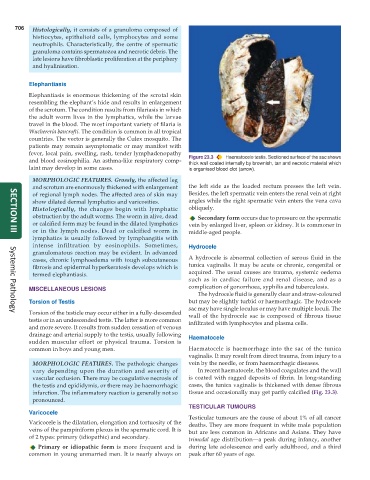
           and blood eosinophilia. An asthma-like respiratory comp-  Figure 23.3  Haematocele testis. Sectioned surface of the sac shows
                                                               thick wall coated internally by brownish, tan and necrotic material which
           laint may develop in some cases.                    is organised blood clot (arrow).
            MORPHOLOGIC FEATURES. Grossly, the affected leg
            and scrotum are enormously thickened with enlargement  the left side as the loaded rectum presses the left vein.
            of regional lymph nodes. The affected area of skin may  Besides, the left spermatic vein enters the renal vein at right
            show dilated dermal lymphatics and varicosities.   angles while the right spermatic vein enters the vena cava
            Histologically, the changes begin with lymphatic   obliquely.
            obstruction by the adult worms. The worm in alive, dead  Secondary form occurs due to pressure on the spermatic
            or calcified form may be found in the dilated lymphatics  vein by enlarged liver, spleen or kidney. It is commoner in
            or in the lymph nodes. Dead or calcified worm in   middle-aged people.
     SECTION III
            lymphatics is usually followed by lymphangitis with
            intense infiltration by eosinophils. Sometimes,    Hydrocele
            granulomatous reaction may be evident. In advanced
            cases, chronic lymphoedema with tough subcutaneous  A hydrocele is abnormal collection of serous fluid in the
            fibrosis and epidermal hyperkeratosis develops which is  tunica vaginalis. It may be acute or chronic, congenital or
            termed elephantiasis.                              acquired. The usual causes are trauma, systemic oedema
                                                               such as in cardiac failure and renal disease, and as a
           MISCELLANEOUS LESIONS                               complication of gonorrhoea, syphilis and tuberculosis.
                                                                  The hydrocele fluid is generally clear and straw-coloured
           Torsion of Testis                                   but may be slightly turbid or haemorrhagic. The hydrocele
                                                               sac may have single loculus or may have multiple loculi. The
           Torsion of the testicle may occur either in a fully-descended  wall of the hydrocele sac is composed of fibrous tissue
     Systemic Pathology
           testis or in an undescended testis. The latter is more common  infiltrated with lymphocytes and plasma cells.
           and more severe. It results from sudden cessation of venous
           drainage and arterial supply to the testis, usually following  Haematocele
           sudden muscular effort or physical trauma. Torsion is
           common in boys and young men.                       Haematocele is haemorrhage into the sac of the tunica
                                                               vaginalis. It may result from direct trauma, from injury to a
            MORPHOLOGIC FEATURES. The pathologic changes       vein by the needle, or from haemorrhagic diseases.
            vary depending upon the duration and severity of      In recent haematocele, the blood coagulates and the wall
            vascular occlusion. There may be coagulative necrosis of  is coated with ragged deposits of fibrin. In long-standing
            the testis and epididymis, or there may be haemorrhagic  cases, the tunica vaginalis is thickened with dense fibrous
            infarction. The inflammatory reaction is generally not so  tissue and occasionally may get partly calcified (Fig. 23.3).
            pronounced.
                                                               TESTICULAR TUMOURS
           Varicocele
                                                               Testicular tumours are the cause of about 1% of all cancer
           Varicocele is the dilatation, elongation and tortuosity of the  deaths. They are more frequent in white male population
           veins of the pampiniform plexus in the spermatic cord. It is  but are less common in Africans and Asians. They have
           of 2 types: primary (idiopathic) and secondary.     trimodal age distribution—a peak during infancy, another
              Primary or idiopathic form is more frequent and is  during late adolescence and early adulthood, and a third
           common in young unmarried men. It is nearly always on  peak after 60 years of age.

