


Page 720 - Textbook of Pathology, 6th Edition
P. 720
704


     SECTION III


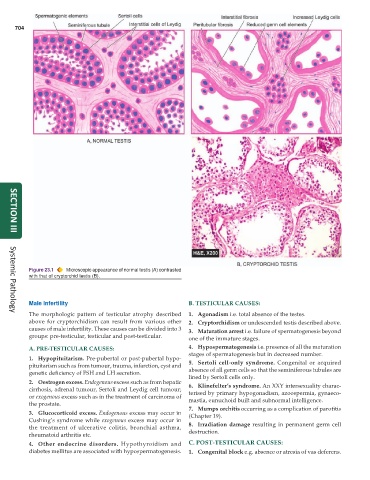
           Figure 23.1  Microscopic appearance of normal testis (A) contrasted
           with that of cryptorchid testis (B).


           Male Infertility                                    B. TESTICULAR CAUSES:
           The morphologic pattern of testicular atrophy described  1. Agonadism i.e. total absence of the testes.
     Systemic Pathology
           above for cryptorchidism can result from various other  2. Cryptorchidism or undescended testis described above.
           causes of male infertility. These causes can be divided into 3  3. Maturation arrest i.e. failure of spermatogenesis beyond
           groups: pre-testicular, testicular and post-testicular.  one of the immature stages.
           A. PRE-TESTICULAR CAUSES:                           4. Hypospermatogenesis i.e. presence of all the maturation
                                                               stages of spermatogenesis but in decreased number.
           1. Hypopituitarism. Pre-pubertal or post-pubertal hypo-
           pituitarism such as from tumour, trauma, infarction, cyst and  5. Sertoli cell-only syndrome. Congenital or acquired
           genetic deficiency of FSH and LH secretion.         absence of all germ cells so that the seminiferous tubules are
                                                               lined by Sertoli cells only.
           2. Oestrogen excess. Endogenous excess such as from hepatic  6. Klinefelter’s syndrome. An XXY intersexuality charac-
           cirrhosis, adrenal tumour, Sertoli and Leydig cell tumour;  terised by primary hypogonadism, azoospermia, gynaeco-
           or exogenous excess such as in the treatment of carcinoma of  mastia, eunuchoid built and subnormal intelligence.
           the prostate.                                       7. Mumps orchitis occurring as a complication of parotitis
           3. Glucocorticoid excess. Endogenous excess may occur in  (Chapter 19).
           Cushing’s syndrome while exogenous excess may occur in
           the treatment of ulcerative colitis, bronchial asthma,  8. Irradiation damage resulting in permanent germ cell
           rheumatoid arthritis etc.                           destruction.
           4. Other endocrine disorders.  Hypothyroidism and   C. POST-TESTICULAR CAUSES:
           diabetes mellitus are associated with hypospermatogenesis.  1. Congenital block e.g. absence or atresia of vas deferens.

