


Page 713 - Textbook of Pathology, 6th Edition
P. 713
697


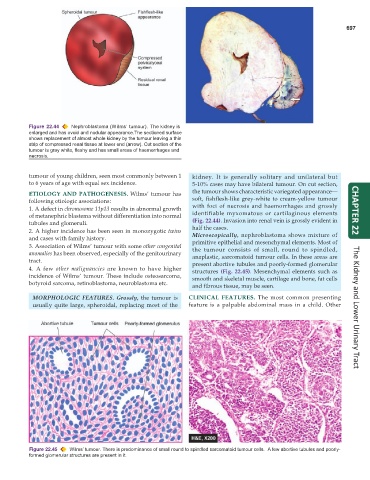
           Figure 22.44  Nephroblastoma (W ilms’  tumour).  The kidney is
           enlarged and has ovoid and nodular appearance. The sectioned surface
           shows replacement of almost whole kidney by the tumour leaving a thin
           strip of compressed renal tissue at lower end (arrow). Cut section of the
           tumour is gray white, fleshy and has small areas of haemorrhages and
           necrosis.


           tumour of young children, seen most commonly between 1  kidney. It is generally solitary and unilateral but
           to 6 years of age with equal sex incidence.           5-10% cases may have bilateral tumour. On cut section,
           ETIOLOGY AND PATHOGENESIS. Wilms’ tumour has          the tumour shows characteristic variegated appearance—
           following etiologic associations:                     soft, fishflesh-like grey-white to cream-yellow tumour
           1. A defect in chromosome 11p13 results in abnormal growth  with foci of necrosis and haemorrhages and grossly  CHAPTER 22
           of metanephric blastema without differentiation into normal  identifiable myxomatous or cartilaginous elements
           tubules and glomeruli.                                (Fig. 22.44). Invasion into renal vein is grossly evident in
                                                                 half the cases.
           2. A higher incidence has been seen in monozygotic twins  Microscopically, nephroblastoma shows mixture of
           and cases with family history.
                                                                 primitive epithelial and mesenchymal elements. Most of
           3. Association of Wilms’ tumour with some other congenital  the tumour consists of small, round to spindled,
           anomalies has been observed, especially of the genitourinary  anaplastic, sarcomatoid tumour cells. In these areas are
           tract.                                                present abortive tubules and poorly-formed glomerular
           4. A few  other malignancies are known to have higher  structures (Fig. 22.45). Mesenchymal elements such as
           incidence of Wilms’ tumour. These include osteosarcoma,  smooth and skeletal muscle, cartilage and bone, fat cells
           botyroid sarcoma, retinoblastoma, neuroblastoma etc.
                                                                 and fibrous tissue, may be seen.
            MORPHOLOGIC FEATURES. Grossly, the tumour is       CLINICAL FEATURES.  The most common presenting
            usually quite large, spheroidal, replacing most of the  feature is a palpable abdominal mass in a child. Other  The Kidney and Lower Urinary Tract


           Figure 22.45  Wilms’ tumour. There is predominance of small round to spindled sarcomatoid tumour cells.  A few abortive tubules and poorly-
           formed glomerular structures are present in it.

