


Page 716 - Textbook of Pathology, 6th Edition
P. 716
700 urethritis (Chapter 4). The pathologic changes are similar to  3. Dietary factors. Certain carcinogenic metabolites of
           inflammation of the lower urinary tract elsewhere but  tryptophan are excreted in urine of patients with bladder
           strictures are less common than following gonococcal  cancer. These metabolites have been shown to induce bladder
           infection of the urethra.                           cancer in experimental animals. The role of artificial
                                                               sweeteners like saccharin, coffee or caffeine and chronic
           TUMOURS                                             alcoholism in the etiology of bladder cancer in man is
                                                               controversial.
           Majority of lower urinary tract tumours are epithelial. Both
           benign and malignant tumours occur; the latter being more  4. Local lesions. A number of local lesions in the bladder
           common. About 90% of malignant tumours of the lower  predispose to the development of bladder cancer. These
           urinary tract occur in the urinary bladder, 8% in the renal  include ectopia vesicae (extrophied bladder), vesical
           pelvis and remaining 2% are seen in the urethra or ureters.  diverticulum, leukoplakia of the bladder mucosa and urinary
                                                               diversion in defunctionalised bladder. All these conditions
           TUMOURS OF THE BLADDER                              are associated with squamous metaplasia and high incidence
                                                               of bladder cancer.
           Epithelial (Urothelial) Bladder Tumours             5. Smoking. Tobacco smoking is associated with 2 to 3 fold

           More than 90% of bladder tumours arise from transitional  increased risk of developing bladder cancer, probably due
           epithelial (urothelium) lining of the bladder in continuity  to increased urinary excretion of carcinogenic substances.
           with the epithelial lining of the renal pelvis, ureters, and the  6. Drugs. Immunosuppressive therapy with cyclo-
           major part of the urethra. Though many workers consider  phosphamide and patients having analgesic-abuse
           all transitional cell tumours as transitional cell carcinoma,  (phenacetin-) nephropathy have high risk of developing
           others distinguish true transitional cell papilloma from grade  bladder cancer.
           I transitional cell carcinoma.                         Multicentric nature of urothelial cancer and high rate of
              Bladder cancer comprises about 3% of all cancers. Most  recurrence has led to the hypothesis that a field effect in the
           of the cases appear beyond 5th decade of life with 3-times  urothelium is responsible for this form of cancer. This is
           higher preponderance in males than females.         responsible for polychronotropism in bladder cancer i.e. the
           ETIOPATHOGENESIS. Urothelial tumours in the urinary  tumour tends to recur with time and develops at new
           tract are typically multifocal and the pattern of disease  locations within the urinary tract.
           becomes apparent over a period of years. A number of   Several cytogentic abnormalities have been seen in
     SECTION III
           environmental and host factors are associated with increased  bladder cancer. These include mutations in p53, RB gene and
           risk of bladder cancer. These are as under:         p21 gene, all of which are associated with higher rate of
                                                               recurrences and metastasis.
           1. Industrial occupations. Workers in industries that
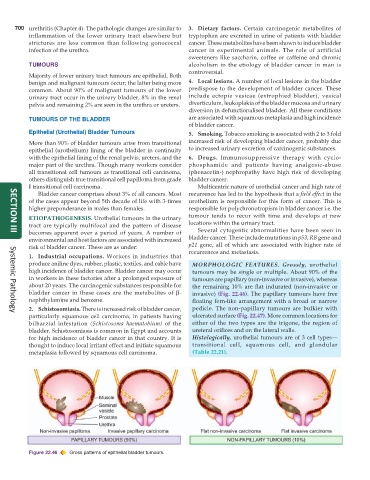
           produce aniline dyes, rubber, plastic, textiles, and cable have  MORPHOLOGIC FEATURES. Grossly, urothelial
           high incidence of bladder cancer. Bladder cancer may occur  tumours may be single or multiple. About 90% of the
           in workers in these factories after a prolonged exposure of  tumours are papillary (non-invasive or invasive), whereas
           about 20 years. The carcinogenic substances responsible for  the remaining 10% are flat indurated (non-invasive or
           bladder cancer in these cases are the metabolites of  β-  invasive) (Fig. 22.46). The papillary tumours have free
           naphthylamine and benzene.                            floating fern-like arrangement with a broad or narrow
           2. Schistosomiasis. There is increased risk of bladder cancer,  pedicle. The non-papillary tumours are bulkier with
     Systemic Pathology
           particularly squamous cell carcinoma, in patients having  ulcerated surface (Fig. 22.47). More common locations for
           bilharzial infestation  (Schistosoma haematobium) of the  either of the two types are the trigone, the region of
           bladder. Schistosomiasis is common in Egypt and accounts  ureteral orifices and on the lateral walls.
           for high incidence of bladder cancer in that country. It is  Histologically, urothelial tumours are of 3 cell types—
           thought to induce local irritant effect and initiate squamous  transitional cell, squamous cell, and glandular
           metaplasia followed by squamous cell carcinoma.       (Table 22.21).


           Figure 22.46  Gross patterns of epithelial bladder tumours.

