


Page 721 - Textbook of Pathology, 6th Edition
P. 721
2. Acquired  block e.g. due to gonorrhoea and surgical  Tuberculous Epididymo-orchitis                   705
           intervention.                                       Tuberculosis invariably begins in the epididymis and
           3. Impaired sperm motility in the presence of normal sperm  spreads to involve the testis. Tuberculous epididymo-orchitis
           counts e.g. immotile cilia syndrome (Chapter 17).   is generally secondary tuberculosis from elsewhere in the
                                                               body. It may occur either by direct spread from genitourinary
           INFLAMMATIONS                                       tuberculosis such as tuberculous seminal vesiculitis,
           Inflammation of the testis is termed as orchitis and of  prostatitis and renal tuberculosis, or may reach by
           epididymis is called as epididymitis; the latter being more  haematogenous spread of infection such as from tuberculosis
           common. A combination epididymo-orchitis may also occur.  of the lungs. Primary genital tuberculosis may occur rarely.
           A few important types are described below.
                                                                 MORPHOLOGIC FEATURES. Grossly, discrete,
           Non-specific Epididymitis and Orchitis                yellowish, caseous necrotic areas are seen.
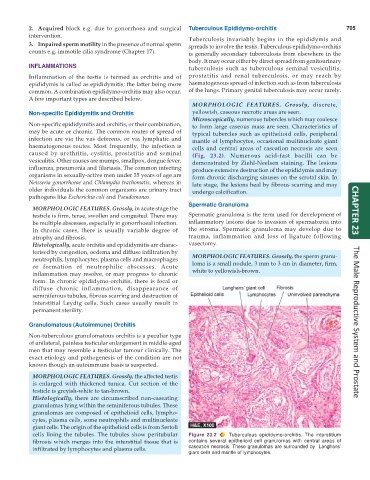
                                                                 Microscopically, numerous tubercles which may coalesce
           Non-specific epididymitis and orchitis, or their combination,  to form large caseous mass are seen. Characteristics of
           may be acute or chronic. The common routes of spread of  typical tubercles such as epithelioid cells, peripheral
           infection are via the vas deferens, or via lymphatic and  mantle of lymphocytes, occasional multinucleate giant
           haematogenous routes. Most frequently, the infection is  cells and central areas of caseation necrosis are seen
           caused by urethritis, cystitis, prostatitis and seminal  (Fig. 23.2).  Numerous acid-fast bacilli can be
           vesiculitis. Other causes are mumps, smallpox, dengue fever,  demonstrated by Ziehl-Neelsen staining. The lesions
           influenza, pneumonia and filariasis. The common infecting  produce extensive destruction of the epididymis and may
           organisms in sexually-active men under 35 years of age are  form chronic discharging sinuses on the scrotal skin. In
           Neisseria gonorrhoeae and Chlamydia trachomatis, whereas in  late stage, the lesions heal by fibrous scarring and may
           older individuals the common organisms are urinary tract  undergo calcification.
           pathogens like Escherichia coli and Pseudomonas.
                                                               Spermatic Granuloma
            MORPHOLOGIC FEATURES. Grossly, in acute stage the                                                         CHAPTER 23
            testicle is firm, tense, swollen and congested. There may  Spermatic granuloma is the term used for development of
            be multiple abscesses, especially in gonorrhoeal infection.  inflammatory lesions due to invasion of spermatozoa into
            In chronic cases, there is usually variable degree of  the stroma. Spermatic granuloma may develop due to
            atrophy and fibrosis.                              trauma, inflammation and loss of ligature following
            Histologically, acute orchitis and epididymitis are charac-  vasectomy.
            terised by congestion, oedema and diffuse infiltration by
            neutrophils, lymphocytes, plasma cells and macrophages  MORPHOLOGIC FEATURES. Grossly, the sperm granu-
            or formation of neutrophilic abscesses. Acute        loma is a small nodule, 3 mm to 3 cm in diameter, firm,
            inflammation may resolve, or may progress to chronic  white to yellowish-brown.
            form. In chronic epididymo-orchitis, there is focal or
            diffuse chronic inflammation, disappearance of
            seminiferous tubules, fibrous scarring and destruction of
            interstitial Leydig cells. Such cases usually result in
            permanent sterility.

           Granulomatous (Autoimmune) Orchitis                                                                        The Male Reproductive System and Prostate
           Non-tuberculous granulomatous orchitis is a peculiar type
           of unilateral, painless testicular enlargement in middle-aged
           men that may resemble a testicular tumour clinically. The
           exact etiology and pathogenesis of the condition are not
           known though an autoimmune basis is suspected.

            MORPHOLOGIC FEATURES. Grossly, the affected testis
            is enlarged with thickened tunica. Cut section of the
            testicle is greyish-white to tan-brown.
            Histologically,  there are circumscribed non-caseating
            granulomas lying within the seminiferous tubules. These
            granulomas are composed of epithelioid cells, lympho-
            cytes, plasma cells, some neutrophils and multinucleate
            giant cells. The origin of the epithelioid cells is from Sertoli
            cells lining the tubules. The tubules show peritubular  Figure 23.2  Tuberculous epididymo-orchitis.  The interstitium
            fibrosis which merges into the interstitial tissue that is  contains several epithelioid cell granulomas with central areas of
            infiltrated by lymphocytes and plasma cells.       caseation necrosis. These granulomas are surrounded by  Langhans’
                                                               giant cells and mantle of lymphocytes.

