


Page 717 - Textbook of Pathology, 6th Edition
P. 717
carcinomas. Similar foci may be present in the ureters and 701
renal pelvis. The malignant potential of epithelial
hyperplasia and dysplasia is uncertain but carcinoma in
situ is certainly precancerous and is currently included as
grade 0 transitional cell carcinoma. Carcinoma in situ is
characterised by anaplastic malignant cells confined to
layers superficial to basement membrane of the bladder
mucosa. These pathologic changes can be induced in
experimental animals by chemical carcinogens. Therefore,
it is reasonable to assume that these stages are precursors
of invasive bladder cancer.
3. Transitional cell carcinoma (TCC). This is the commo-
nest cancer of the bladder. The widely accepted
classification of Mostofi (1960) adopted by the American
Bladder Tumour Registry divides TCC into 3 grades. The
basis for this grading depends upon 2 features: the degree
of anaplasia and the extent of invasion.
The criteria for anaplasia are: increased cellularity,
nuclear crowding, deranged cellular polarity, failure of
normal orientation from base to the surface, variation in
cell size and shape, variation in nuclear chromatin pattern,
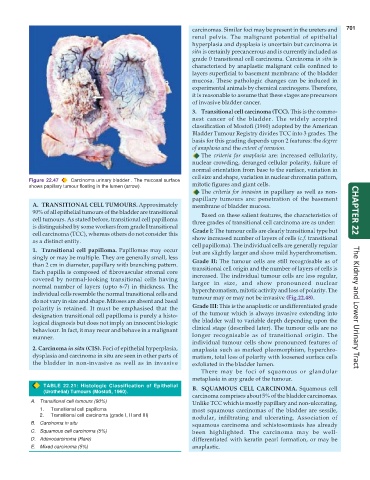
Figure 22.47 Carcinoma urinary bladder . The mucosal surface
shows papillary tumour floating in the lumen (arrow). mitotic figures and giant cells.
The criteria for invasion in papillary as well as non-
papillary tumours are: penetration of the basement
A. TRANSITIONAL CELL TUMOURS. Approximately membrane of bladder mucosa.
90% of all epithelial tumours of the bladder are transitional Based on these salient features, the characteristics of CHAPTER 22
cell tumours. As stated before, transitional cell papilloma three grades of transitional cell carcinoma are as under:
is distinguished by some workers from grade I transitional
cell carcinoma (TCC), whereas others do not consider this Grade I: The tumour cells are clearly transitional type but
as a distinct entity. show increased number of layers of cells (c.f. transitional
cell papilloma). The individual cells are generally regular
1. Transitional cell papilloma. Papillomas may occur but are slightly larger and show mild hyperchromatism.
singly or may be multiple. They are generally small, less Grade II: The tumour cells are still recognisable as of
than 2 cm in diameter, papillary with branching pattern. transitional cell origin and the number of layers of cells is
Each papilla is composed of fibrovascular stromal core increased. The individual tumour cells are less regular,
covered by normal-looking transitional cells having larger in size, and show pronounced nuclear
normal number of layers (upto 6-7) in thickness. The hyperchromatism, mitotic activity and loss of polarity. The
individual cells resemble the normal transitional cells and tumour may or may not be invasive (Fig.22.48).
do not vary in size and shape. Mitoses are absent and basal
polarity is retained. It must be emphasised that the Grade III: This is the anaplastic or undifferentiated grade The Kidney and Lower Urinary Tract
designation transitional cell papilloma is purely a histo- of the tumour which is always invasive extending into
logical diagnosis but does not imply an innocent biologic the bladder wall to variable depth depending upon the
behaviour. In fact, it may recur and behave in a malignant clinical stage (described later). The tumour cells are no
manner. longer recognisable as of transitional origin. The
individual tumour cells show pronounced features of
2. Carcinoma in situ (CIS). Foci of epithelial hyperplasia, anaplasia such as marked pleomorphism, hyperchro-
dysplasia and carcinoma in situ are seen in other parts of matism, total loss of polarity with loosened surface cells
the bladder in non-invasive as well as in invasive exfoliated in the bladder lumen.
There may be foci of squamous or glandular
metaplasia in any grade of the tumour.
TABLE 22.21: Histologic Classification of Epithelial B. SQUAMOUS CELL CARCINOMA. Squamous cell
(Urothelial) Tumours (Mostofi, 1960).
carcinoma comprises about 5% of the bladder carcinomas.
A. Transitional cell tumours (90%) Unlike TCC which is mostly papillary and non-ulcerating,
1. Transitional cell papilloma most squamous carcinomas of the bladder are sessile,
2. Transitional cell carcinoma (grade I, II and III) nodular, infiltrating and ulcerating. Association of
B. Carcinoma in situ squamous carcinoma and schistosomiasis has already
C. Squamous cell carcinoma (5%) been highlighted. The carcinoma may be well-
D. Adenocarcinoma (Rare) differentiated with keratin pearl formation, or may be
E. Mixed carcinoma (5%) anaplastic.

