


Page 732 - Textbook of Pathology, 6th Edition
P. 732
716 HPV types 16 and 18 are strongly implicated and their DNA  The prostate has numerous blood vessels and nerves. In
           has been documented in the nuclei of malignant cells.  addition to nervous control, the prostate is an endocrine-
           Carcinoma of the penis is quite rare in Jews and Muslims  dependent organ. Based on hormonal responsiveness, the
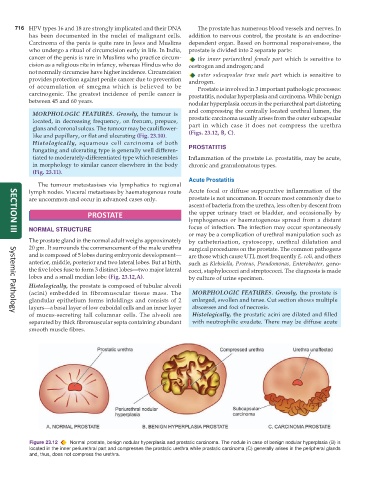
           who undergo a ritual of circumcision early in life. In India,  prostate is divided into 2 separate parts:
           cancer of the penis is rare in Muslims who practice circum-  the inner periurethral female part which is sensitive to
           cision as a religious rite in infancy, whereas Hindus who do  oestrogen and androgen; and
           not normally circumcise have higher incidence. Circumcision  outer subcapsular true male part which is sensitive to
           provides protection against penile cancer due to prevention  androgen.
           of accumulation of smegma which is believed to be      Prostate is involved in 3 important pathologic processes:
           carcinogenic. The greatest incidence of penile cancer is  prostatitis, nodular hyperplasia and carcinoma. While benign
           between 45 and 60 years.                            nodular hyperplasia occurs in the periurethral part distorting
                                                               and compressing the centrally located urethral lumen, the
            MORPHOLOGIC FEATURES. Grossly,  the tumour is
            located, in decreasing frequency, on frenum, prepuce,  prostatic carcinoma usually arises from the outer subcapsular
            glans and coronal sulcus. The tumour may be cauliflower-  part in which case it does not compress the urethra
            like and papillary, or flat and ulcerating (Fig. 23.10).  (Figs. 23.12, B, C).
            Histologically,  squamous cell carcinoma of both
            fungating and ulcerating type is generally well differen-  PROSTATITIS
            tiated to moderately-differentiated type which resembles  Inflammation of the prostate i.e. prostatitis, may be acute,
            in morphology to similar cancer elsewhere in the body  chronic and granulomatous types.
            (Fig. 23.11).
                                                               Acute Prostatitis
              The tumour metastasises via lymphatics to regional
           lymph nodes. Visceral metastases by haematogenous route  Acute focal or diffuse suppurative inflammation of the
           are uncommon and occur in advanced cases only.      prostate is not uncommon. It occurs most commonly due to
                                                               ascent of bacteria from the urethra, less often by descent from
                              PROSTATE                         the upper urinary tract or bladder, and occasionally by
                                                               lymphogenous or haematogenous spread from a distant
           NORMAL STRUCTURE                                    focus of infection. The infection may occur spontaneously
                                                               or may be a complication of urethral manipulation such as
     SECTION III
           The prostate gland in the normal adult weighs approximately  by catheterisation, cystoscopy, urethral dilatation and
           20 gm. It surrounds the commencement of the male urethra  surgical procedures on the prostate. The common pathogens
           and is composed of 5 lobes during embryonic development—  are those which cause UTI, most frequently E. coli, and others
           anterior, middle, posterior and two lateral lobes. But at birth,  such as Klebsiella, Proteus, Pseudomonas, Enterobacter, gono-
           the five lobes fuse to form 3 distinct lobes—two major lateral  cocci, staphylococci and streptococci. The diagnosis is made
           lobes and a small median lobe (Fig. 23.12,A).       by culture of urine specimen.
           Histologically, the prostate is composed of tubular alveoli
           (acini) embedded in fibromuscular tissue mass. The    MORPHOLOGIC FEATURES. Grossly, the prostate is
           glandular epithelium forms infoldings and consists of 2  enlarged, swollen and tense. Cut section shows multiple
           layers—a basal layer of low cuboidal cells and an inner layer  abscesses and foci of necrosis.
           of mucus-secreting tall columnar cells. The alveoli are  Histologically, the prostatic acini are dilated and filled
     Systemic Pathology
           separated by thick fibromuscular septa containing abundant  with neutrophilic exudate. There may be diffuse acute
           smooth muscle fibres.


           Figure 23.12  Normal prostate, benign nodular hyperplasia and prostatic carcinoma. The nodule in case of benign nodular hyperplasia (B) is
           located in the inner periurethral part and compresses the prostatic urethra while prostatic carcinoma (C) generally arises in the peripheral glands
           and, thus, does not compress the urethra.

