


Page 727 - Textbook of Pathology, 6th Edition
P. 727
tumour giant cells are frequently present. Haemorrhage  4. There may be presence of both intracellular and  711
            and necrosis are common.                             extracellular PAS-positive hyaline globules, many of which
            3. The stroma is not as distinct as in seminoma and may  contain AFP.
            contain variable amount of primitive mesenchyme.
                                                               Polyembryoma
              Embryonal carcinoma is more aggressive and less
           radiosensitive than seminoma. Chemotherapy is more  Polyembryoma is defined as a tumour composed predo-
           effective in treating this tumour.                  minantly of embryoid bodies. Embryoid bodies are structures
                                                               containing a disc and cavities surrounded by loose
           Yolk Sac Tumour                                     mesenchyme simulating an embryo of about 2 weeks’
           (Synonyms: Endodermal Sinus Tumour,                 gestation. Polyembryoma is extremely rare but embryoid
           Orchioblastoma, Infantile Embryonal Carcinoma)      bodies may be present with embryonal carcinoma and
                                                               teratoma.
           This characteristic tumour is the most common testicular
           tumour of infants and young children upto the age of 4 years.  Choriocarcinoma
           In adults, however, yolk sac tumour in pure form is rare but
           may be present as the major component in 40% of germ cell  Pure choriocarcinoma is a highly malignant tumour compo-
           tumours. AFP levels are elevated in 100% cases of yolk sac  sed of elements consisting of syncytiotrophoblast and
           tumours.                                            cytotrophoblast.
                                                                  However, pure form is extremely rare and occurs more
            MORPHOLOGIC FEATURES. Grossly,  the tumour is      often in combination with other germ cell tumours. The
            generally soft, yellow-white, mucoid with areas of necrosis  patients are generally in their 2nd decade of life. The primary
            and haemorrhages.                                  tumour is usually small and the patient may manifest initially
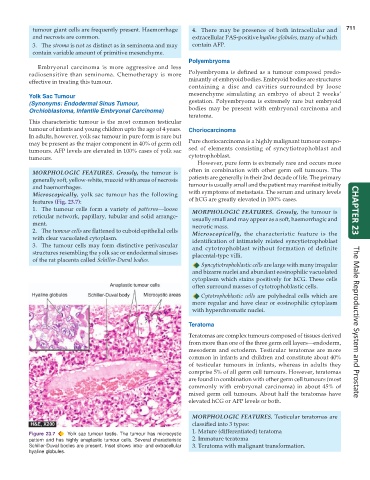
            Microscopically,  yolk sac tumour has the following  with symptoms of metastasis. The serum and urinary levels
            features (Fig. 23.7):                              of hCG are greatly elevated in 100% cases.
            1. The tumour cells form a variety of  patterns—loose  MORPHOLOGIC FEATURES. Grossly,  the tumour is      CHAPTER 23
            reticular network, papillary, tubular and solid arrange-  usually small and may appear as a soft, haemorrhagic and
            ment.                                                necrotic mass.
            2. The tumour cells are flattened to cuboid epithelial cells  Microscopically,  the characteristic feature is the
            with clear vacuolated cytoplasm.                     identification of intimately related syncytiotrophoblast
            3. The tumour cells may form distinctive perivascular  and cytotrophoblast without formation of definite
            structures resembling the yolk sac or endodermal sinuses  placental-type villi.
            of the rat placenta called Schiller-Duval bodies.
                                                                    Syncytiotrophoblastic cells are large with many irregular
                                                                 and bizarre nuclei and abundant eosinophilic vacuolated
                                                                 cytoplasm which stains positively for hCG. These cells
                                                                 often surround masses of cytotrophoblastic cells.
                                                                    Cytotrophoblastic cells are polyhedral cells which are
                                                                 more regular and have clear or eosinophilic cytoplasm
                                                                 with hyperchromatic nuclei.

                                                               Teratoma                                               The Male Reproductive System and Prostate
                                                               Teratomas are complex tumours composed of tissues derived
                                                               from more than one of the three germ cell layers—endoderm,
                                                               mesoderm and ectoderm. Testicular teratomas are more
                                                               common in infants and children and constitute about 40%
                                                               of testicular tumours in infants, whereas in adults they
                                                               comprise 5% of all germ cell tumours. However, teratomas
                                                               are found in combination with other germ cell tumours (most
                                                               commonly with embryonal carcinoma) in about 45% of
                                                               mixed germ cell tumours. About half the teratomas have
                                                               elevated hCG or AFP levels or both.

                                                                 MORPHOLOGIC FEATURES. Testicular teratomas are
                                                                 classified into 3 types:
                                                                 1. Mature (differentiated) teratoma
           Figure 23.7  Yolk sac tumour testis. The tumour has microcystic
           pattern and has highly anaplastic tumour cells. Several characteristic  2. Immature teratoma
           Schiller-Duval bodies are present. Inset shows intra- and extracellular  3. Teratoma with malignant transformation.
           hyaline globules.

