


Page 728 - Textbook of Pathology, 6th Edition
P. 728
712


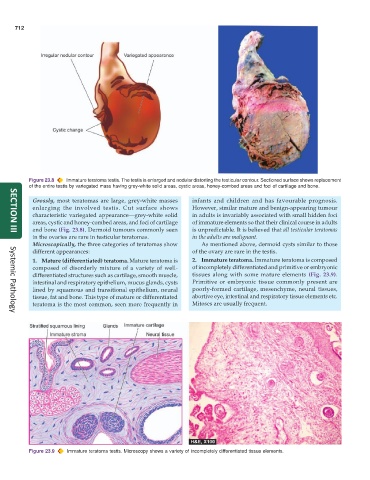
           Figure 23.8  Immature teratoma testis. The testis is enlarged and nodular distorting the testicular contour. Sectioned surface shows replacement
           of the entire testis by variegated mass having grey-white solid areas, cystic areas, honey-combed areas and foci of cartilage and bone.

            Grossly, most teratomas are large, grey-white masses  infants and children and has favourable prognosis.
            enlarging the involved testis. Cut surface shows     However, similar mature and benign-appearing tumour
            characteristic variegated appearance—grey-white solid  in adults is invariably associated with small hidden foci
            areas, cystic and honey-combed areas, and foci of cartilage  of immature elements so that their clinical course in adults
            and bone (Fig. 23.8). Dermoid tumours commonly seen  is unpredictable. It is believed that all testicular teratomas
     SECTION III
            in the ovaries are rare in testicular teratomas.     in the adults are malignant.
            Microscopically, the three categories of teratomas show  As mentioned above, dermoid cysts similar to those
            different appearances:                               of the ovary are rare in the testis.
            1. Mature (differentiated) teratoma. Mature teratoma is  2. Immature teratoma. Immature teratoma is composed
            composed of disorderly mixture of a variety of well-  of incompletely differentiated and primitive or embryonic
            differentiated structures such as cartilage, smooth muscle,  tissues along with some mature elements (Fig. 23.9).
            intestinal and respiratory epithelium, mucus glands, cysts  Primitive or embryonic tissue commonly present are
            lined by squamous and transitional epithelium, neural  poorly-formed cartilage, mesenchyme, neural tissues,
            tissue, fat and bone. This type of mature or differentiated  abortive eye, intestinal and respiratory tissue elements etc.
            teratoma is the most common, seen more frequently in  Mitoses are usually frequent.
     Systemic Pathology


           Figure 23.9  Immature teratoma testis. Microscopy shows a variety of incompletely differentiated tissue elements.

