


Page 733 - Textbook of Pathology, 6th Edition
P. 733
inflammatory infiltrate. Oedema, hyperaemia and foci of  of 50 years and its incidence approaches 75-80% in men above  717
            necrosis frequently accompany acute inflammatory   80 years. However, symptomatic BEP producing urinary tract
            involvement.                                       obstruction and requiring surgical treatment occurs in 5-10%
                                                               of cases only.
           Chronic Prostatitis                                 ETIOLOGY. The cause of BEP has not been fully established.
           Chronic prostatitis is more common and foci of chronic  However, a few etiologic factors such as endocrinologic, racial,
           inflammation are frequently present in the prostate of men  inflammation  and  arteriosclerosis have been implicated but
           above 40 years of age. Chronic prostatitis is usually  endocrine basis for hyperplasia has been more fully
           asymptomatic but may cause allergic reactions, iritis, neuritis  investigated and considered a strong possibility in its genesis.
           or arthritis.                                       It has been found that both sexes elaborate androgen and
                                                               oestrogen, though the level of androgen is high in males and
           Chronic prostatitis is of 2 types—bacterial and abacterial.  that of oestrogen is high in females. With advancing age,
              Chronic bacterial prostatitis is caused in much the same  there is decline in the level of androgen and a corresponding
           way and by the same organisms as the acute prostatitis. It is  rise of oestrogen in the males. The periurethral inner prostate
           generally a consequence of recurrent UTI. Diagnosis is made  which is primarily involved in BEP is responsive to the rising
           by detection of more than 10-12 leucocytes per high power  level of oestrogen, whereas the outer prostate which is mainly
           field in expressed prostatic secretions, and by positive culture  involved in the carcinoma is responsive to androgen. A
           of urine specimen and prostatic secretions. This condition is  plausible hypothesis suggested is that there is synergistic
           more difficult to treat since antibiotics penetrate the prostate  stimulation of the prostate by both hormones—the oestrogen
           poorly.                                             acting to sensitise the prostatic tissue to the growth
              Chronic abacterial prostatitis is more common. There is  promoting effect of  dihydroxy-testosterone derived from
           no history of recurrent UTI and culture of urine and prostatic  plasma testosterone.
           secretions is always negative, though leucocytosis is
           demonstrable in prostatic secretions. The pathogens   MORPHOLOGIC FEATURES. Grossly, the enlarged pro-
           implicated are  Chlamydia trachomatis and  Ureaplasma  state is nodular, smooth and firm and weighs 2-4 times  CHAPTER 23
           urealyticum.                                          its normal weight i.e. may weigh up to 40-80 gm. The
                                                                 appearance on cut section varies depending upon whether
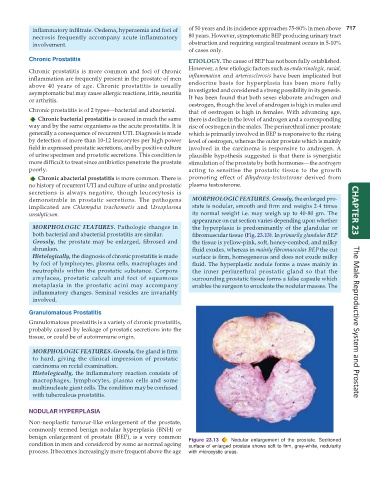
            MORPHOLOGIC FEATURES.  Pathologic changes in         the hyperplasia is predominantly of the glandular or
            both bacterial and abacterial prostatitis are similar.  fibromuscular tissue (Fig. 23.13). In primarily glandular BEP
            Grossly,  the prostate may be enlarged, fibrosed and  the tissue is yellow-pink, soft, honey-combed, and milky
            shrunken.                                            fluid exudes, whereas in mainly fibromuscular BEP the cut
            Histologically, the diagnosis of chronic prostatitis is made  surface is firm, homogeneous and does not exude milky
            by foci of lymphocytes, plasma cells, macrophages and  fluid. The hyperplastic nodule forms a mass mainly in
            neutrophils within the prostatic substance. Corpora  the inner periurethral prostatic gland so that the
            amylacea, prostatic calculi and foci of squamous     surrounding prostatic tissue forms a false capsule which
            metaplasia in the prostatic acini may accompany      enables the surgeon to enucleate the nodular masses. The
            inflammatory changes. Seminal vesicles are invariably
            involved.

           Granulomatous Prostatitis
           Granulomatous prostatitis is a variety of chronic prostatitis,                                             The Male Reproductive System and Prostate
           probably caused by leakage of prostatic secretions into the
           tissue, or could be of autoimmune origin.

            MORPHOLOGIC FEATURES. Grossly, the gland is firm
            to hard, giving the clinical impression of prostatic
            carcinoma on rectal examination.
            Histologically, the inflammatory reaction consists of
            macrophages, lymphocytes, plasma cells and some
            multinucleate giant cells. The condition may be confused
            with tuberculous prostatitis.

           NODULAR HYPERPLASIA
           Non-neoplastic tumour-like enlargement of the prostate,
           commonly termed benign nodular hyperplasia (BNH) or
           benign enlargement of prostate (BEP), is a very common  Figure 23.13  Nodular enlargement of the prostate. Sectioned
           condition in men and considered by some as normal ageing  surface of enlarged prostate shows soft to firm, grey-white, nodularity
           process. It becomes increasingly more frequent above the age  with microcystic areas.

