


Page 735 - Textbook of Pathology, 6th Edition
P. 735
719


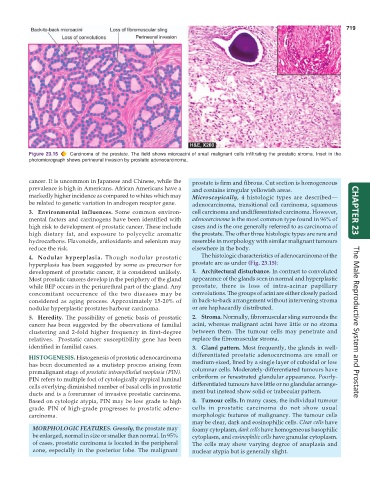
           Figure 23.15  Carcinoma of the prostate. The field shows microacini of small malignant cells infiltrating the prostatic stroma. Inset in the
           photomicrograph shows perineural invasion by prostatic adenocarcinoma.


           cancer. It is uncommon in Japanese and Chinese, while the  prostate is firm and fibrous. Cut section is homogeneous
           prevalence is high in Americans. African Americans have a  and contains irregular yellowish areas.
           markedly higher incidence as compared to whites which may  Microscopically,  4 histologic types are described—
           be related to genetic variation in androgen receptor gene.  adenocarcinoma, transitional cell carcinoma, squamous
           3. Environmental influences. Some common environ-     cell carcinoma and undifferentiated carcinoma. However,  CHAPTER 23
           mental factors and carcinogens have been identified with  adenocarcinoma is the most common type found in 96% of
           high risk to development of prostatic cancer. These include  cases and is the one generally referred to as carcinoma of
           high dietary fat, and exposure to polycyclic aromatic  the prostate. The other three histologic types are rare and
           hydrocarbons. Flavonoids, antioxidants and selenium may  resemble in morphology with similar malignant tumours
           reduce the risk.                                      elsewhere in the body.
           4. Nodular hyperplasia.  Though nodular prostatic        The histologic characteristics of adenocarcinoma of the
           hyperplasia has been suggested by some as precursor for  prostate are as under (Fig. 23.15):
           development of prostatic cancer, it is considered unlikely.  1. Architectural disturbance. In contrast to convoluted
           Most prostatic cancers develop in the periphery of the gland  appearance of the glands seen in normal and hyperplastic
           while BEP occurs in the periurethral part of the gland. Any  prostate, there is loss of intra-acinar papillary
           concomitant occurrence of the two diseases may be     convolutions. The groups of acini are either closely packed
           considered as aging process. Approximately 15-20% of  in back-to-back arrangement without intervening stroma
           nodular hyperplastic prostates harbour carcinoma.     or are haphazardly distributed.
           5. Heredity. The possibility of genetic basis of prostatic  2. Stroma. Normally, fibromuscular sling surrounds the
           cancer has been suggested by the observations of familial  acini, whereas malignant acini have little or no stroma  The Male Reproductive System and Prostate
           clustering and 2-fold higher frequency in first-degree  between them. The tumour cells may penetrate and
           relatives.  Prostatic cancer susceptibility gene has been  replace the fibromuscular stroma.
           identified in familial cases.                         3. Gland pattern. Most frequently, the glands in well-
           HISTOGENESIS. Histogenesis of prostatic adenocarcinoma  differentiated prostatic adenocarcinoma are small or
           has been documented as a mutistep process arising from  medium-sized, lined by a single layer of cuboidal or low
           premalignant stage of prostatic intraepithelial neoplasia (PIN).  columnar cells. Moderately-differentiated tumours have
           PIN refers to multiple foci of cytologically atypical luminal  cribriform or fenestrated glandular appearance. Poorly-
           cells overlying diminished number of basal cells in prostatic  differentiated tumours have little or no glandular arrange-
           ducts and is a forerunner of invasive prostatic carcinoma.  ment but instead show solid or trabecular pattern.
           Based on cytologic atypia, PIN may be low grade to high  4. Tumour cells. In many cases, the individual tumour
           grade. PIN of high-grade progresses to prostatic adeno-  cells in prostatic carcinoma do not show usual
           carcinoma.                                            morphologic features of malignancy. The tumour cells
                                                                 may be clear, dark and eosinophilic cells. Clear cells have
            MORPHOLOGIC FEATURES. Grossly, the prostate may      foamy cytoplasm, dark cells have homogeneous basophilic
            be enlarged, normal in size or smaller than normal. In 95%  cytoplasm, and eosinophilic cells have granular cytoplasm.
            of cases, prostatic carcinoma is located in the peripheral  The cells may show varying degree of anaplasia and
            zone, especially in the posterior lobe. The malignant  nuclear atypia but is generally slight.

