


Page 734 - Textbook of Pathology, 6th Edition
P. 734
718


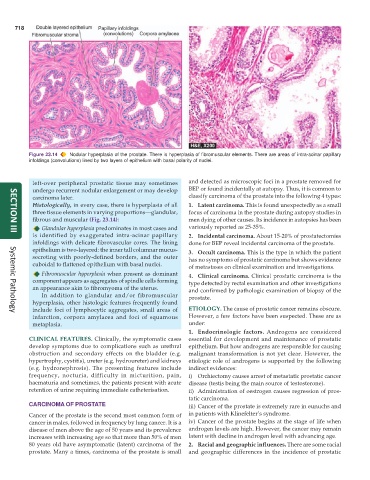
           Figure 23.14  Nodular hyperplasia of the prostate. There is hyperplasia of fibromuscular elements. There are areas of intra-acinar papillary
           infoldings (convolutions) lined by two layers of epithelium with basal polarity of nuclei.


            left-over peripheral prostatic tissue may sometimes  and detected as microscopic foci in a prostate removed for
            undergo recurrent nodular enlargement or may develop  BEP or found incidentally at autopsy. Thus, it is common to
            carcinoma later.                                   classify carcinoma of the prostate into the following 4 types:
            Histologically, in every case, there is hyperplasia of all  1. Latent carcinoma. This is found unexpectedly as a small
            three tissue elements in varying proportions—glandular,  focus of carcinoma in the prostate during autopsy studies in
            fibrous and muscular (Fig. 23.14):                 men dying of other causes. Its incidence in autopsies has been
               Glandular hyperplasia predominates in most cases and  variously reported as 25-35%.
            is identified by exaggerated intra-acinar papillary  2. Incidental carcinoma. About 15-20% of prostatectomies
     SECTION III
            infoldings with delicate fibrovascular cores. The lining  done for BEP reveal incidental carcinoma of the prostate.
            epithelium is two-layered: the inner tall columnar mucus-  3. Occult carcinoma. This is the type in which the patient
            secreting with poorly-defined borders, and the outer  has no symptoms of prostatic carcinoma but shows evidence
            cuboidal to flattened epithelium with basal nuclei.  of metastases on clinical examination and investigations.
               Fibromuscular hyperplasia when present as dominant  4. Clinical carcinoma. Clinical prostatic carcinoma is the
            component appears as aggregates of spindle cells forming  type detected by rectal examination and other investigations
            an appearance akin to fibromyoma of the uterus.    and confirmed by pathologic examination of biopsy of the
               In addition to glandular and/or fibromuscular   prostate.
            hyperplasia, other histologic features frequently found
            include foci of lymphocytic aggregates, small areas of  ETIOLOGY. The cause of prostatic cancer remains obscure.
     Systemic Pathology
            infarction, corpora amylacea and foci of squamous  However, a few factors have been suspected. These are as
            metaplasia.                                        under:
                                                               1. Endocrinologic factors. Androgens are considered
           CLINICAL FEATURES. Clinically, the symptomatic cases  essential for development and maintenance of prostatic
           develop symptoms due to complications such as urethral  epithelium. But how androgens are responsible for causing
           obstruction and secondary effects on the bladder (e.g.  malignant transformation is not yet clear. However, the
           hypertrophy, cystitis), ureter (e.g. hydroureter) and kidneys  etiologic role of androgens is supported by the following
           (e.g. hydronephrosis). The presenting features include  indirect evidences:
           frequency, nocturia, difficulty in micturition, pain,  i) Orchiectomy causes arrest of metastatic prostatic cancer
           haematuria and sometimes, the patients present with acute  disease (testis being the main source of testosterone).
           retention of urine requiring immediate catheterisation.  ii) Administration of oestrogen causes regression of pros-
                                                               tatic carcinoma.
           CARCINOMA OF PROSTATE                               iii) Cancer of the prostate is extremely rare in eunuchs and
           Cancer of the prostate is the second most common form of  in patients with Klinefelter’s syndrome.
           cancer in males, followed in frequency by lung cancer. It is a  iv) Cancer of the prostate begins at the stage of life when
           disease of men above the age of 50 years and its prevalence  androgen levels are high. However, the cancer may remain
           increases with increasing age so that more than 50% of men  latent with decline in androgen level with advancing age.
           80 years old have asymptomatic (latent) carcinoma of the  2. Racial and geographic influences. There are some racial
           prostate. Many a times, carcinoma of the prostate is small  and geographic differences in the incidence of prostatic

