


Page 769 - Textbook of Pathology, 6th Edition
P. 769
753


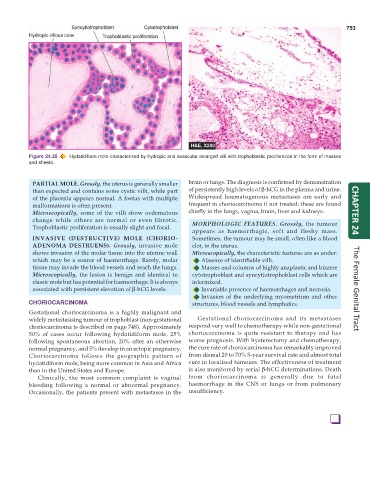
           Figure 24.35  Hydatidiform mole characterised by hydropic and avascular enlarged villi with trophoblastic proliferation in the form of masses
           and sheets.


            PARTIAL MOLE. Grossly, the uterus is generally smaller  brain or lungs. The diagnosis is confirmed by demonstration
            than expected and contains some cystic villi, while part  of persistently high levels of β-hCG in the plasma and urine.
            of the placenta appears normal. A foetus with multiple  Widespread haematogenous metastases are early and
            malformations is often present.                    frequent in choriocarcinoma if not treated; these are found
            Microscopically, some of the villi show oedematous  chiefly in the lungs, vagina, brain, liver and kidneys.  CHAPTER 24
            change while others are normal or even fibrotic.     MORPHOLOGIC FEATURES. Grossly, the tumour
            Trophoblastic proliferation is usually slight and focal.
                                                                 appears as haemorrhagic, soft and fleshy mass.
            INVASIVE (DESTRUCTIVE) MOLE (CHORIO-                 Sometimes, the tumour may be small, often like a blood
            ADENOMA DESTRUENS).  Grossly, invasive mole          clot, in the uterus.
            shows invasion of the molar tissue into the uterine wall  Microscopically, the characteristic features are as under:
            which may be a source of haemorrhage. Rarely, molar     Absence of identifiable villi.
            tissue may invade the blood vessels and reach the lungs.  Masses and columns of highly anaplastic and bizarre
            Microscopically, the lesion is benign and identical to  cytotrophoblast and syncytiotrophoblast cells which are
            classic mole but has potential for haemorrhage. It is always  intermixed.
            associated with persistent elevation of β-hCG levels.   Invariable presence of haemorrhages and necrosis.  The Female Genital Tract
                                                                    Invasion of the underlying myometrium and other
           CHORIOCARCINOMA                                       structures, blood vessels and lymphatics.
           Gestational choriocarcinoma is a highly malignant and
           widely metastasising tumour of trophoblast (non-gestational  Gestational choriocarcinoma and its metastases
           choriocarcinoma is described on page 748). Approximately  respond very well to chemotherapy while non-gestational
           50% of cases occur following hydatidiform mole, 25%  choriocarcinoma is quite resistant to therapy and has
           following spontaneous abortion, 20% after an otherwise  worse prognosis. With hysterectomy and chemotherapy,
           normal pregnancy, and 5% develop in an ectopic pregnancy.  the cure rate of choriocarcinoma has remarkably improved
           Choriocarcinoma follows the geographic pattern of   from dismal 20 to 70% 5-year survival rate and almost total
           hydatidiform mole, being more common in Asia and Africa  cure in localised tumours. The effectiveness of treatment
           than in the United States and Europe.               is also monitored by serial β-hCG determinations. Death
              Clinically, the most common complaint is vaginal  from choriocarcinoma is generally due to fatal
           bleeding following a normal or abnormal pregnancy.  haemorrhage in the CNS or lungs or from pulmonary
           Occasionally, the patients present with metastases in the  insufficiency.


                                                                                                              ❑

