


Page 765 - Textbook of Pathology, 6th Edition
P. 765
749


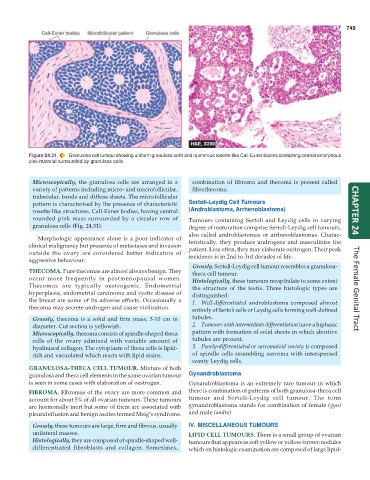
           Figure 24.31  Granulosa cell tumour showing uniform granulosa cells and numerous rosette-like Call-Exner bodies containing central amorphous
           pink material surrounded by granulosa cells.


            Microscopically, the granulosa cells are arranged in a  combination of fibroma and thecoma is present called
            variety of patterns including micro- and macrofollicular,  fibrothecoma.
            trabecular, bands and diffuse sheets. The microfollicular
            pattern is characterised by the presence of characteristic  Sertoli-Leydig Cell Tumours
            rosette-like structures, Call-Exner bodies, having central  (Androblastoma, Arrhenoblastoma)              CHAPTER 24
            rounded pink mass surrounded by a circular row of  Tumours containing Sertoli and Leydig cells in varying
            granulosa cells (Fig. 24.31).                      degree of maturation comprise Sertoli-Leydig cell tumours,
                                                               also called androblastomas or arrhenoblastomas. Charac-
              Morphologic appearance alone is a poor indicator of
           clinical malignancy but presence of metastases and invasion  teristically, they produce androgens and masculinise the
                                                               patient. Less often, they may elaborate oestrogen. Their peak
           outside the ovary are considered better indicators of  incidence is in 2nd to 3rd decades of life.
           aggressive behaviour.
                                                                 Grossly, Sertoli-Leydig cell tumour resembles a granulosa-
           THECOMA. Pure thecomas are almost always benign. They  theca cell tumour.
           occur more frequently in postmenopausal women.        Histologically, these tumours recapitulate to some extent
           Thecomas are typically oestrogenic. Endometrial       the structure of the testis. Three histologic types are
           hyperplasia, endometrial carcinoma and cystic disease of  distinguished:                                   The Female Genital Tract
           the breast are some of its adverse effects. Occasionally a  1. Well-differentiated androblastoma composed almost
           thecoma may secrete androgen and cause virilisation.
                                                                 entirely of Sertoli cells or Leydig cells forming well-defined
            Grossly, thecoma is a solid and firm mass, 5-10 cm in  tubules.
            diameter. Cut section is yellowish.                  2. Tumours with intermediate differentiation have a biphasic
            Microscopically, thecoma consists of spindle-shaped theca  pattern with formation of solid sheets in which abortive
            cells of the ovary admixed with variable amount of   tubules are present.
            hyalinised collagen. The cytoplasm of theca cells is lipid-  3. Poorly-differentiated or sarcomatoid variety is composed
            rich and vacuolated which reacts with lipid stains.  of spindle cells resembling sarcoma with interspersed
                                                                 scanty Leydig cells.
           GRANULOSA-THECA CELL TUMOUR. Mixture of both
           granulosa and theca cell elements in the same ovarian tumour  Gynandroblastoma
           is seen in some cases with elaboration of oestrogen.  Gynandroblastoma is an extremely rare tumour in which
           FIBROMA. Fibromas of the ovary are more common and  there is combination of patterns of both granulosa-theca cell
           account for about 5% of all ovarian tumours. These tumours  tumour and Sertoli-Leydig cell tumour. The term
           are hormonally inert but some of them are associated with  gynandroblastoma stands for combination of female (gyn)
           pleural effusion and benign ascites termed Meig’s syndrome.  and male (andro).
            Grossly, these tumours are large, firm and fibrous, usually  IV. MISCELLANEOUS TUMOURS
            unilateral masses.                                 LIPID CELL TUMOURS. There is a small group of ovarian
            Histologically, they are composed of spindle-shaped well-  tumours that appears as soft yellow or yellow-brown nodules
            differentiated fibroblasts and collagen. Sometimes,  which on histologic examination are composed of large lipid-

