


Page 766 - Textbook of Pathology, 6th Edition
P. 766
750


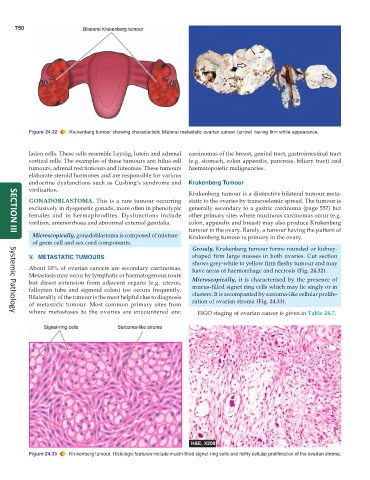
           Figure 24.32  Krukenberg tumour showing characteristic bilateral metastatic ovarian cancer (arrow) having firm white appearance.


           laden cells. These cells resemble Leydig, lutein and adrenal  carcinomas of the breast, genital tract, gastrointestinal tract
           cortical cells. The examples of these tumours are: hilus cell  (e.g. stomach, colon appendix, pancreas, biliary tract) and
           tumours, adrenal rest tumours and luteomas. These tumours  haematopoietic malignancies.
           elaborate steroid hormones and are responsible for various
           endocrine dysfunctions such as Cushing’s syndrome and  Krukenberg Tumour
           virilisation.
                                                               Krukenberg tumour is a distinctive bilateral tumour meta-
           GONADOBLASTOMA. This is a rare tumour occurring     static to the ovaries by transcoelomic spread. The tumour is
           exclusively in dysgenetic gonads, more often in phenotypic  generally secondary to a gastric carcinoma (page 557) but
           females and in hermaphrodites. Dysfunctions include  other primary sites where mucinous carcinomas occur (e.g.
           virilism, amenorrhoea and abnormal external genitalia.  colon, appendix and breast) may also produce Krukenberg
                                                               tumour in the ovary. Rarely, a tumour having the pattern of
            Microscopically, gonadoblastoma is composed of mixture  Krukenberg tumour is primary in the ovary.
     SECTION III
            of germ cell and sex cord components.
                                                                 Grossly, Krukenberg tumour forms rounded or kidney-
           V. METASTATIC TUMOURS                                 shaped firm large masses in both ovaries. Cut section
                                                                 shows grey-white to yellow firm fleshy tumour and may
           About 10% of ovarian cancers are secondary carcinomas.  have areas of haemorrhage and necrosis (Fig. 24.32).
           Metastasis may occur by lymphatic or haematogenous route
           but direct extension from adjacent organs (e.g. uterus,  Microscopically, it is characterised by the presence of
           fallopian tube and sigmoid colon) too occurs frequently.  mucus-filled signet ring cells which may lie singly or in
           Bilaterality of the tumour is the most helpful clue to diagnosis  clusters. It is accompanied by sarcoma-like cellular prolife-
           of metastatic tumour. Most common primary sites from  ration of ovarian stroma (Fig. 24.33).
           where metastases to the ovaries are encountered are:   FIGO staging of ovarian cancer is given in Table 24.7.
     Systemic Pathology


           Figure 24.33  Krukenberg tumour. Histologic features include mucin-filled signet-ring cells and richly cellular proliferation of the ovarian stroma.

