


Page 764 - Textbook of Pathology, 6th Edition
P. 764
748 Endodermal Sinus (Yolk Sac) Tumour
           Endodermal sinus tumour or yolk sac tumour is the second
           most common germ cell tumour occurring most frequently
           in children and young women. More often, endodermal
           sinus tumour is found in combination with other germ cell
           tumours rather than in pure form. The tumour is rich in
           alphafetoprotein (AFP) and α-1-antitrypsin. The tumour is
           usually unilateral but may metastasise to the other ovary.
           It is a highly aggressive and rapidly growing tumour.
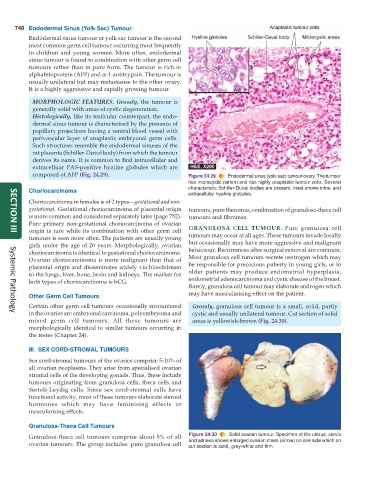
            MORPHOLOGIC FEATURES. Grossly, the tumour is
            generally solid with areas of cystic degeneration.
            Histologically, like its testicular counterpart, the endo-
            dermal sinus tumour is characterised by the presence of
            papillary projections having a central blood vessel with
            perivascular layer of anaplastic embryonal germ cells.
            Such structures resemble the endodermal sinuses of the
            rat placenta (Schiller-Duval body) from which the tumour
            derives its name. It is common to find intracellular and
            extracelluar PAS-positive hyaline globules which are
            composed of AFP (Fig. 24.29).                      Figure 24.29  Endodermal sinus (yolk sac) tumour ovary. The tumour
                                                               has microcystic pattern and has highly anaplastic tumour cells. Several
           Choriocarcinoma                                     characteristic Schiller-Duval bodies are present. Inset shows intra- and
                                                               extracellular hyaline globules.
           Choriocarcinoma in females is of 2 types—gestational and non-
           gestational. Gestational choriocarcinoma of placental origin  tumours, pure thecomas, combination of granulosa-theca cell
           is more common and considered separately later (page 752).  tumours and fibromas.
           Pure primary non-gestational choriocarcinoma of ovarian
           origin is rare while its combination with other germ cell  GRANULOSA CELL TUMOUR.  Pure granulosa cell
     SECTION III
           tumours is seen more often. The patients are usually young  tumours may occur at all ages. These tumours invade locally
           girls under the age of 20 years. Morphologically, ovarian  but occasionally may have more aggressive and malignant
           choriocarcinoma is identical to gestational choriocarcinoma.  behaviour. Recurrences after surgical removal are common.
           Ovarian choriocarcinoma is more malignant than that of  Most granulosa cell tumours secrete oestrogen which may
           placental origin and disseminates widely via bloodstream  be responsible for precocious puberty in young girls, or in
           to the lungs, liver, bone, brain and kidneys. The marker for  older patients may produce endometrial hyperplasia,
           both types of choriocarcinoma is hCG.               endometrial adenocarcinoma and cystic disease of the breast.
                                                               Rarely, granulosa cell tumour may elaborate androgen which
                                                               may have masculinising effect on the patient.
           Other Germ Cell Tumours
           Certain other germ cell tumours occasionally encountered  Grossly, granulosa cell tumour is a small, solid, partly
           in the ovaries are embryonal carcinoma, polyembryoma and  cystic and usually unilateral tumour. Cut section of solid
     Systemic Pathology
           mixed germ cell tumours. All these tumours are        areas is yellowish-brown (Fig. 24.30).
           morphologically identical to similar tumours occurring in
           the testes (Chapter 24).

           III. SEX CORD-STROMAL TUMOURS

           Sex cord-stromal tumours of the ovaries comprise 5-10% of
           all ovarian neoplasms. They arise from specialised ovarian
           stromal cells of the developing gonads. Thus, these include
           tumours originating from granulosa cells, theca cells and
           Sertoli-Leydig cells. Since sex cord-stromal cells have
           functional activity, most of these tumours elaborate steroid
           hormones which may have feminising effects or
           masculinising effects.

           Granulosa-Theca Cell Tumours
           Granulosa-theca cell tumours comprise about 5% of all  Figure 24.30  Solid ovarian tumour. Specimen of the uterus, cervix
           ovarian tumours. The group includes: pure granulosa cell  and adnexa shows enlarged ovarian mass (arrow) on one side which on
                                                               cut section is solid, grey-white and firm.

