


Page 774 - Textbook of Pathology, 6th Edition
P. 774
758


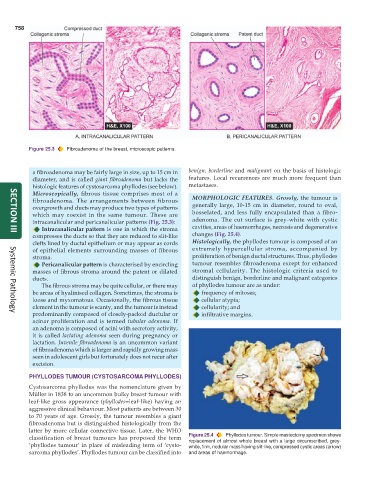
           Figure 25.3  Fibroadenoma of the breast, microscopic patterns.


            a fibroadenoma may be fairly large in size, up to 15 cm in  benign, borderline and  malignant on the basis of histologic
            diameter, and is called giant fibroadenoma but lacks the  features. Local recurrences are much more frequent than
            histologic features of cystosarcoma phyllodes (see below).  metastases.
            Microscopically, fibrous tissue comprises most of a
            fibroadenoma. The arrangements between fibrous       MORPHOLOGIC FEATURES. Grossly, the tumour is
            overgrowth and ducts may produce two types of patterns  generally large, 10-15 cm in diameter, round to oval,
            which may coexist in the same tumour. These are      bosselated, and less fully encapsulated than a fibro-
            intracanalicular and pericanalicular patterns (Fig. 25.3):  adenoma. The cut surface is grey-white with cystic
               Intracanalicular pattern is one in which the stroma  cavities, areas of haemorrhages, necrosis and degenerative
            compresses the ducts so that they are reduced to slit-like  changes (Fig. 25.4).
     SECTION III
            clefts lined by ductal epithelium or may appear as cords  Histologically, the phyllodes tumour is composed of an
            of epithelial elements surrounding masses of fibrous  extremely hypercellular stroma, accompanied by
            stroma.                                              proliferation of benign ductal structures. Thus, phyllodes
               Pericanalicular pattern is characterised by encircling  tumour resembles fibroadenoma except for enhanced
            masses of fibrous stroma around the patent or dilated  stromal cellularity. The histologic criteria used to
            ducts.                                               distinguish benign, borderline and malignant categories
               The fibrous stroma may be quite cellular, or there may  of phyllodes tumour are as under:
            be areas of hyalinised collagen. Sometimes, the stroma is  frequency of mitoses;
            loose and myxomatous. Occasionally, the fibrous tissue  cellular atypia;
            element in the tumour is scanty, and the tumour is instead  cellularity; and
            predominantly composed of closely-packed ductular or    infiltrative margins.
     Systemic Pathology
            acinar proliferation and is termed  tubular adenoma. If
            an adenoma is composed of acini with secretory activity,
            it is called  lactating adenoma seen during pregnancy or
            lactation. Juvenile fibroadenoma is an uncommon variant
            of fibroadenoma which is larger and rapidly growing mass
            seen in adolescent girls but fortunately does not recur after
            excision.

           PHYLLODES TUMOUR (CYSTOSARCOMA PHYLLODES)
           Cystosarcoma phyllodes was the nomenclature given by
           Müller in 1838 to an uncommon bulky breast tumour with
           leaf-like gross appearance (phyllodes=leaf-like) having an
           aggressive clinical behaviour. Most patients are between 30
           to 70 years of age. Grossly, the tumour resembles a giant
           fibroadenoma but is distinguished histologically from the
           latter by more cellular connective tissue. Later, the WHO
           classification of breast tumours has proposed the term  Figure 25.4  Phyllodes tumour. Simple mastectomy specimen shows
                                                               replacement of almost whole breast with a large circumscribed, grey-
           ‘phyllodes tumour’ in place of misleading term of ‘cysto-  white, firm, nodular mass having slit-like, compressed cystic areas (arrow)
           sarcoma phyllodes’. Phyllodes tumour can be classified into  and areas of haemorrhage.

