


Page 777 - Textbook of Pathology, 6th Edition
P. 777
761


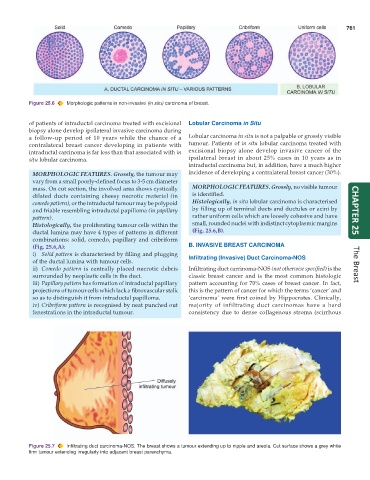
           Figure 25.6  Morphologic patterns in non-invasive (in situ) carcinoma of breast.


           of patients of intraductal carcinoma treated with excisional  Lobular Carcinoma in Situ
           biopsy alone develop ipsilateral invasive carcinoma during
           a follow-up period of 10 years while the chance of a  Lobular carcinoma in situ is not a palpable or grossly visible
           contralateral breast cancer developing in patients with  tumour. Patients of in situ lobular carcinoma treated with
           intraductal carcinoma is far less than that associated with in  excisional biopsy alone develop invasive cancer of the
           situ lobular carcinoma.                             ipsilateral breast in about 25% cases in 10 years as in
                                                               intraductal carcinoma but, in addition, have a much higher
            MORPHOLOGIC FEATURES. Grossly, the tumour may      incidence of developing a contralateral breast cancer (30%).
            vary from a small poorly-defined focus to 3-5 cm diameter
            mass. On cut section, the involved area shows cystically  MORPHOLOGIC FEATURES. Grossly, no visible tumour
            dilated ducts containing cheesy necrotic material  (in  is identified.
            comedo pattern), or the intraductal tumour may be polypoid  Histologically, in situ lobular carcinoma is characterised
            and friable resembling intraductal papilloma (in papillary  by filling up of terminal ducts and ductules or acini by  CHAPTER 25
            pattern).                                            rather uniform cells which are loosely cohesive and have
            Histologically, the proliferating tumour cells within the  small, rounded nuclei with indistinct cytoplasmic margins
            ductal lumina may have 4 types of patterns in different  (Fig. 25.6,B).
            combinations: solid, comedo, papillary and cribriform
            (Fig. 25.6,A):                                     B. INVASIVE BREAST CARCINOMA
            i) Solid pattern is characterised by filling and plugging
            of the ductal lumina with tumour cells.            Infiltrating (Invasive) Duct Carcinoma-NOS
            ii) Comedo pattern  is centrally placed necrotic debris  Infiltrating duct carcinoma-NOS (not otherwise specified) is the  The Breast
            surrounded by neoplastic cells in the duct.        classic breast cancer and is the most common histologic
            iii) Papillary pattern has formation of intraductal papillary  pattern accounting for 70% cases of breast cancer. In fact,
            projections of tumour cells which lack a fibrovascular stalk  this is the pattern of cancer for which the terms ‘cancer’ and
            so as to distinguish it from intraductal papilloma.  ‘carcinoma’ were first coined by Hippocrates. Clinically,
            iv) Cribriform pattern is recognised by neat punched out  majority of infiltrating duct carcinomas have a hard
            fenestrations in the intraductal tumour.           consistency due to dense collagenous stroma (scirrhous


           Figure 25.7  Infiltrating duct carcinoma-NOS. The breast shows a tumour extending up to nipple and areola. Cut surface shows a grey white
           firm tumour extending irregularly into adjacent breast parenchyma.

