


Page 778 - Textbook of Pathology, 6th Edition
P. 778
762


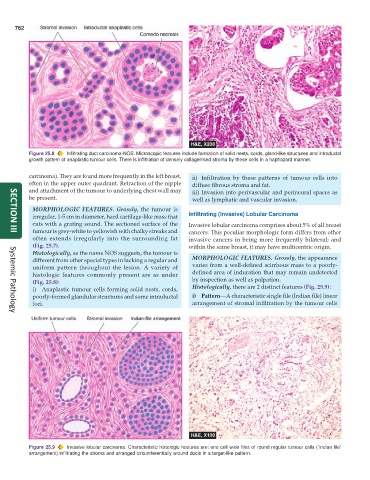
           Figure 25.8  Infiltrating duct carcinoma-NOS. Microscopic features include formation of solid nests, cords, gland-like structures and intraductal
           growth pattern of anaplastic tumour cells. There is infiltration of densely collagenised stroma by these cells in a haphazard manner.


           carcinoma). They are found more frequently in the left breast,  ii) Infiltration by these patterns of tumour cells into
           often in the upper outer quadrant. Retraction of the nipple  diffuse fibrous stroma and fat.
           and attachment of the tumour to underlying chest wall may  iii) Invasion into perivascular and perineural spaces as
           be present.                                           well as lymphatic and vascular invasion.
            MORPHOLOGIC FEATURES. Grossly, the tumour is
            irregular, 1-5 cm in diameter, hard cartilage-like mass that  Infiltrating (Invasive) Lobular Carcinoma
            cuts with a grating sound. The sectioned surface of the  Invasive lobular carcinoma comprises about 5% of all breast
            tumour is grey-white to yellowish with chalky streaks and  cancers. This peculiar morphologic form differs from other
     SECTION III
            often extends irregularly into the surrounding fat  invasive cancers in being more frequently bilateral; and
            (Fig. 25.7).                                       within the same breast, it may have multicentric origin.
            Histologically, as the name NOS suggests, the tumour is
            different from other special types in lacking a regular and  MORPHOLOGIC FEATURES. Grossly, the appearance
            uniform pattern throughout the lesion. A variety of  varies from a well-defined scirrhous mass to a poorly-
            histologic features commonly present are as under    defined area of induration that may remain undetected
            (Fig. 25.8):                                         by inspection as well as palpation.
            i) Anaplastic tumour cells forming solid nests, cords,  Histologically, there are 2 distinct features (Fig. 25.9):
            poorly-formed glandular structures and some intraductal  i) Pattern—A characteristic single file (Indian file) linear
            foci.                                                arrangement of stromal infiltration by the tumour cells
     Systemic Pathology


           Figure 25.9  Invasive lobular carcinoma. Characteristic histologic features are: one cell wide files of round regular tumour cells (‘Indian file’
           arrangement) infiltrating the stroma and arranged circumferentially around ducts in a target-like pattern.

