


Page 776 - Textbook of Pathology, 6th Edition
P. 776
760 iii) Women with first childbirth at a late age (over 30 years)
are at greater risk.
iv) Lactation is said to reduce the risk of breast cancer.
v) Bilateral oophorectomy reduces the risk of development
of breast cancer.
vi) Functioning ovarian tumours (e.g. granulosa cell tumour)
which elaborate oestrogen are associated with increased
incidence of breast cancer.
vii) Oestrogen replacement therapy administered to post-
menopausal women may result in increased risk of breast
cancer.
viii) Long-term use of oral contraceptives has been suspected
to predispose to breast cancer but there is no definite
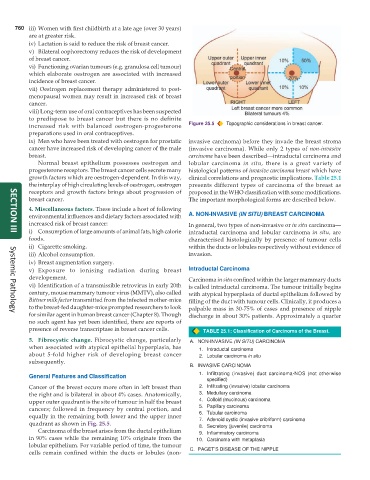
increased risk with balanced oestrogen-progesterone Figure 25.5 Topographic considerations in breast cancer.
preparations used in oral contraceptives.
ix) Men who have been treated with oestrogen for prostatic invasive carcinoma) before they invade the breast stroma
cancer have increased risk of developing cancer of the male (invasive carcinoma). While only 2 types of non-invasive
breast. carcinoma have been described—intraductal carcinoma and
Normal breast epithelium possesses oestrogen and lobular carcinoma in situ, there is a great variety of
progesterone receptors. The breast cancer cells secrete many histological patterns of invasive carcinoma breast which have
growth factors which are oestrogen-dependent. In this way, clinical correlations and prognostic implications. Table 25.1
the interplay of high circulating levels of oestrogen, oestrogen presents different types of carcinoma of the breast as
receptors and growth factors brings about progression of proposed in the WHO classification with some modifications.
breast cancer. The important morphological forms are described below.
4. Miscellaneous factors. These include a host of following
environmental influences and dietary factors associated with A. NON-INVASIVE (IN SITU) BREAST CARCINOMA
increased risk of breast cancer: In general, two types of non-invasive or in situ carcinoma—
i) Consumption of large amounts of animal fats, high calorie intraductal carcinoma and lobular carcinoma in situ, are
SECTION III
foods. characterised histologically by presence of tumour cells
ii) Cigarette smoking. within the ducts or lobules respectively without evidence of
iii) Alcohol consumption. invasion.
iv) Breast augmentation surgery.
v) Exposure to ionising radiation during breast Intraductal Carcinoma
developement. Carcinoma in situ confined within the larger mammary ducts
vi) Identification of a transmissible retrovirus in early 20th is called intraductal carcinoma. The tumour initially begins
century, mouse mammary tumour virus (MMTV), also called with atypical hyperplasia of ductal epithelium followed by
Bittner milk factor transmitted from the infected mother-mice filling of the duct with tumour cells. Clinically, it produces a
to the breast-fed daughter-mice prompted researchers to look palpable mass in 30-75% of cases and presence of nipple
for similar agent in human breast cancer (Chapter 8). Though discharge in about 30% patients. Approximately a quarter
Systemic Pathology
no such agent has yet been identified, there are reports of
presence of reverse transcriptase in breast cancer cells. TABLE 25.1: Classification of Carcinoma of the Breast.
5. Fibrocystic change. Fibrocystic change, particularly A. NON-INVASIVE (IN SITU) CARCINOMA
when associated with atypical epithelial hyperplasia, has 1. Intraductal carcinoma
about 5-fold higher risk of developing breast cancer 2. Lobular carcinoma in situ
subsequently.
B. INVASIVE CARCINOMA
General Features and Classification 1. Infiltrating (invasive) duct carcinoma-NOS (not otherwise
specified)
Cancer of the breast occurs more often in left breast than 2. Infiltrating (invasive) lobular carcinoma
the right and is bilateral in about 4% cases. Anatomically, 3. Medullary carcinoma
upper outer quadrant is the site of tumour in half the breast 4. Colloid (mucinous) carcinoma
cancers; followed in frequency by central portion, and 5. Papillary carcinoma
equally in the remaining both lower and the upper inner 6. Tubular carcinoma
7. Adenoid cystic (invasive cribriform) carcinoma
quadrant as shown in Fig. 25.5. 8. Secretory (juvenile) carcinoma
Carcinoma of the breast arises from the ductal epithelium 9. Inflammatory carcinoma
in 90% cases while the remaining 10% originate from the 10. Carcinoma with metaplasia
lobular epithelium. For variable period of time, the tumour
cells remain confined within the ducts or lobules (non- C. PAGET’S DISEASE OF THE NIPPLE

