


Page 779 - Textbook of Pathology, 6th Edition
P. 779
with very little tendency to gland formation is seen.  Colloid (Mucinous) Carcinoma                     763
            Infiltrating cells may be arranged concentrically around  This is an uncommon pattern of breast cancer occurring more
            ducts in a target-like pattern.                    frequently in older women and is slow-growing. Colloid
            ii) Tumour cytology—Individual tumour cells resemble  carcinoma has better prognosis than the usual infiltrating
            cells of in situ lobular carcinoma. They are round and  duct carcinoma.
            regular with very little pleomorphism and infrequent  MORPHOLOGIC FEATURES. Grossly, the tumour is
            mitoses. Some tumours may show signet-ring cells     usually a soft and gelatinous mass with well-demarcated
            distended with cytoplasmic mucin.
                                                                 borders.
                                                                 Histologically, colloid carcinoma contains large amount
           Medullary Carcinoma
                                                                 of extracellular epithelial mucin and acini filled with
           Medullary carcinoma is a variant of ductal carcinoma and  mucin. Cuboidal to tall columnar tumour cells, some
           comprises about 1% of all breast cancers. The tumour has a  showing mucus vacuolation, are seen floating in large
           significantly better prognosis than the usual infiltrating duct  lakes of mucin (Fig. 25.12).
           carcinoma, probably due to good host immune response in
           the form of lymphoid infiltrate in the tumour stroma.  Other Morphologic Forms
                                                               A few other morphologic forms of invasive breast carcinoma
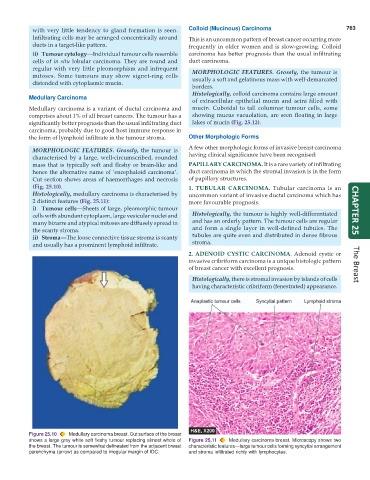
            MORPHOLOGIC FEATURES. Grossly, the tumour is
            characterised by a large, well-circumscribed, rounded  having clinical significance have been recognised:
            mass that is typically soft and fleshy or brain-like and  PAPILLARY CARCINOMA. It is a rare variety of infiltrating
            hence the alternative name of ‘encephaloid carcinoma’.  duct carcinoma in which the stromal invasion is in the form
            Cut section shows areas of haemorrhages and necrosis  of papillary structures.
            (Fig. 25.10).                                      1. TUBULAR CARCINOMA.  Tubular carcinoma is an
            Histologically, medullary carcinoma is characterised by  uncommon variant of invasive ductal carcinoma which has
            2 distinct features (Fig. 25.11):                  more favourable prognosis.
            i) Tumour cells—Sheets of large, pleomorphic tumour                                                       CHAPTER 25
            cells with abundant cytoplasm, large vesicular nuclei and  Histologically, the tumour is highly well-differentiated
            many bizarre and atypical mitoses are diffusely spread in  and has an orderly pattern. The tumour cells are regular
            the scanty stroma.                                   and form a single layer in well-defined tubules. The
            ii) Stroma—The loose connective tissue stroma is scanty  tubules are quite even and distributed in dense fibrous
            and usually has a prominent lymphoid infiltrate.     stroma.
                                                               2. ADENOID CYSTIC CARCINOMA. Adenoid cystic or
                                                               invasive cribriform carcinoma is a unique histologic pattern
                                                               of breast cancer with excellent prognosis.             The Breast

                                                                 Histologically, there is stromal invasion by islands of cells
                                                                 having characteristic cribriform (fenestrated) appearance.


           Figure 25.10  Medullary carcinoma breast. Cut surface of the breast
           shows a large grey white soft fleshy tumour replacing almost whole of  Figure 25.11  Medullary carcinoma breast. Microscopy shows two
           the breast. The tumour is somewhat delineated from the adjacent breast  characteristic features—large tumour cells forming syncytial arrangement
           parenchyma (arrow) as compared to irregular margin of IDC.  and stroma infiltrated richly with lymphocytes.

