


Page 805 - Textbook of Pathology, 6th Edition
P. 805
789


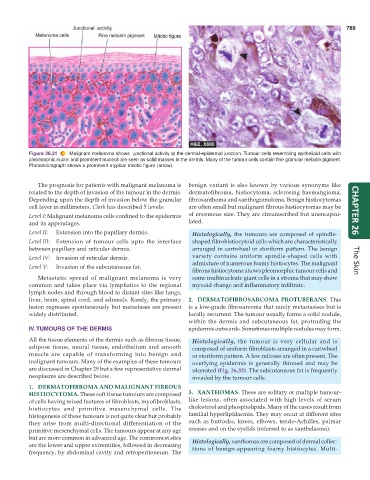
           Figure 26.31  Malignant melanoma shows  junctional activity at the dermal-epidermal junction. Tumour cells resembling epithelioid cells with
           pleomorphic nuclei and prominent nucleoli are seen as solid masses in the dermis. Many of the tumour cells contain fine granular melanin pigment.
           Photomicrograph shows a prominent atypical mitotic figure (arrow).

              The prognosis for patients with malignant melanoma is  benign variant is also known by various synonyms like
           related to the depth of invasion of the tumour in the dermis.  dermatofibroma, histiocytoma, sclerosing haemangioma,
           Depending upon the depth of invasion below the granular  fibroxanthoma and xanthogranuloma. Benign histiocytomas
           cell layer in millimeters, Clark has described 5 levels:  are often small but malignant fibrous histiocytomas may be
           Level I: Malignant melanoma cells confined to the epidermis  of enormous size. They are circumscribed but unencapsu-  CHAPTER 26
           and its appendages.                                 lated.
           Level II:  Extension into the papillary dermis.       Histologically, the tumours are composed of spindle-
           Level III:  Extension of tumour cells upto the interface  shaped fibrohistiocytoid cells which are characteristically
           between papillary and reticular dermis.               arranged in cartwheel or storiform pattern. The benign
           Level IV:  Invasion of reticular dermis.              variety contains uniform spindle-shaped cells with
                                                                 admixture of numerous foamy histiocytes. The malignant  The Skin
           Level V:  Invasion of the subcutaneous fat.
                                                                 fibrous histiocytoma shows pleomorphic tumour cells and
              Metastatic spread of malignant melanoma is very    some multinucleate giant cells in a stroma that may show
           common and takes place via lymphatics to the regional  myxoid change and inflammatory infiltrate.
           lymph nodes and through blood to distant sites like lungs,
           liver, brain, spinal cord, and adrenals. Rarely, the primary  2. DERMATOFIBROSARCOMA PROTUBERANS. This
           lesion regresses spontaneously but metastases are present  is a low-grade fibrosarcoma that rarely metastasises but is
           widely distributed.                                 locally recurrent. The tumour usually forms a solid nodule,
                                                               within the dermis and subcutaneous fat, protruding the
           IV.TUMOURS OF THE DERMIS                            epidermis outwards. Sometimes multiple nodules may form.
           All the tissue elements of the dermis such as fibrous tissue,  Histologically, the tumour is very cellular and is
           adipose tissue, neural tissue, endothelium and smooth  composed of uniform fibroblasts arranged in a cartwheel
           muscle are capable of transforming into benign and    or storiform pattern. A few mitoses are often present. The
           malignant tumours. Many of the examples of these tumours  overlying epidermis is generally thinned and may be
           are discussed in Chapter 29 but a few representative dermal  ulcerated (Fig. 26.32). The subcutaneous fat is frequently
           neoplasms are described below.                        invaded by the tumour cells.
           1. DERMATOFIBROMA AND MALIGNANT FIBROUS
           HISTIOCYTOMA. These soft tissue tumours are composed  3. XANTHOMAS. These are solitary or multiple tumour-
           of cells having mixed features of fibroblasts, myofibroblasts,  like lesions, often associated with high levels of serum
           histiocytes and primitive mesenchymal cells. The    cholesterol and phospholipids. Many of the cases result from
           histogenesis of these tumours is not quite clear but probably  familial hyperlipidaemia. They may occur at different sites
           they arise from multi-directional differentiation of the  such as buttocks, knees, elbows, tendo-Achilles, palmar
           primitive mesenchymal cells. The tumours appear at any age  creases and on the eyelids (referred to as xanthelasma).
           but are more common in advanced age. The commonest sites  Histologically, xanthomas are composed of dermal collec-
           are the lower and upper extremities, followed in decreasing  tions of benign-appearing foamy histiocytes. Multi-
           frequency, by abdominal cavity and retroperitoneum. The

