


Page 800 - Textbook of Pathology, 6th Edition
P. 800
784


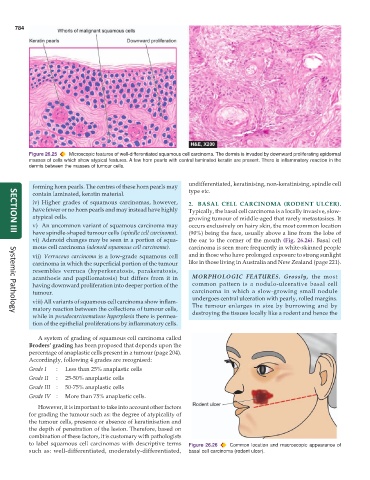
           Figure 26.25  Microscopic features of well-differentiated squamous cell carcinoma. The dermis is invaded by downward proliferating epidermal
           masses of cells which show atypical features. A few horn pearls with central laminated keratin are present. There is inflammatory reaction in the
           dermis between the masses of tumour cells.

                                                               undifferentiated, keratinising, non-keratinising, spindle cell
            forming horn pearls. The centres of these horn pearls may
            contain laminated, keratin material.               type etc.
            iv) Higher grades of squamous carcinomas, however,  2. BASAL CELL CARCINOMA (RODENT ULCER).
            have fewer or no horn pearls and may instead have highly  Typically, the basal cell carcinoma is a locally invasive, slow-
            atypical cells.                                    growing tumour of middle-aged that rarely metastasises. It
            v) An uncommon variant of squamous carcinoma may   occurs exclusively on hairy skin, the most common location
            have spindle-shaped tumour cells (spindle cell carcinoma).  (90%) being the face, usually above a line from the lobe of
     SECTION III
            vi) Adenoid changes may be seen in a portion of squa-  the ear to the corner of the mouth (Fig. 26.26). Basal cell
            mous cell carcinoma (adenoid squamous cell carcinoma).  carcinoma is seen more frequently in white-skinned people
            vii) Verrucous carcinoma is a low-grade squamous cell  and in those who have prolonged exposure to strong sunlight
            carcinoma in which the superficial portion of the tumour  like in those living in Australia and New Zealand (page 221).
            resembles verruca (hyperkeratosis, parakeratosis,
            acanthosis and papillomatosis) but differs from it in  MORPHOLOGIC FEATURES. Grossly, the most
            having downward proliferation into deeper portion of the  common pattern is a nodulo-ulcerative basal cell
            tumour.                                              carcinoma in which a slow-growing small nodule
                                                                 undergoes central ulceration with pearly, rolled margins.
            viii) All variants of squamous cell carcinoma show inflam-
            matory reaction between the collections of tumour cells,  The tumour enlarges in size by burrowing and by
            while in pseudocarcinomatous hyperplasia there is permea-  destroying the tissues locally like a rodent and hence the
     Systemic Pathology
            tion of the epithelial proliferations by inflammatory cells.

              A system of grading of squamous cell carcinoma called
           Broders’ grading has been proposed that depends upon the
           percentage of anaplastic cells present in a tumour (page 204).
           Accordingly, following 4 grades are recognised:
           Grade I  :  Less than 25% anaplastic cells
           Grade II  :  25-50% anaplastic cells
           Grade III  :  50-75% anaplastic cells
           Grade IV :  More than 75% anaplastic cells.
              However, it is important to take into account other factors
           for grading the tumour such as: the degree of atypicality of
           the tumour cells, presence or absence of keratinisation and
           the depth of penetration of the lesion. Therefore, based on
           combination of these factors, it is customary with pathologists
           to label squamous cell carcinomas with descriptive terms  Figure 26.26  Common location and macroscopic appearance of
           such as: well-differentiated, moderately-differentiated,  basal cell carcinoma (rodent ulcer).

