


Page 801 - Textbook of Pathology, 6th Edition
P. 801
785


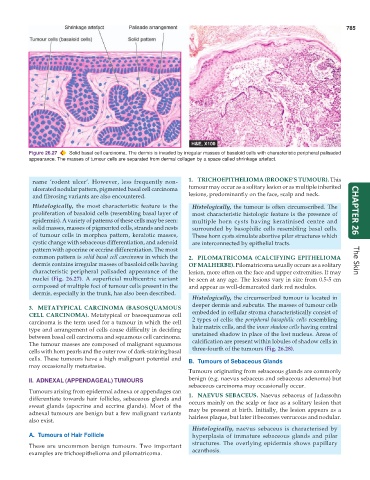
           Figure 26.27  Solid basal cell carcinoma. The dermis is invaded by irregular masses of basaloid cells with characteristic peripheral palisaded
           appearance. The masses of tumour cells are separated from dermal collagen by a space called shrinkage artefact.


            name ‘rodent ulcer’. However, less frequently non-  1. TRICHOEPITHELIOMA (BROOKE’S TUMOUR). This
            ulcerated nodular pattern, pigmented basal cell carcinoma  tumour may occur as a solitary lesion or as multiple inherited
            and fibrosing variants are also encountered.       lesions, predominantly on the face, scalp and neck.
            Histologically, the most characteristic feature is the  Histologically, the tumour is often circumscribed. The
            proliferation of basaloid cells (resembling basal layer of  most characteristic histologic feature is the presence of  CHAPTER 26
            epidermis). A variety of patterns of these cells may be seen:  multiple horn cysts having keratinised centre and
            solid masses, masses of pigmented cells, strands and nests  surrounded by basophilic cells resembling basal cells.
            of tumour cells in morphea pattern, keratotic masses,  These horn cysts simulate abortive pilar structures which
            cystic change with sebaceous differentiation, and adenoid  are interconnected by epithelial tracts.
            pattern with apocrine or eccrine differentiation. The most
            common pattern is solid basal cell carcinoma in which the  2. PILOMATRICOMA (CALCIFYING EPITHELIOMA
            dermis contains irregular masses of basaloid cells having  OF MALHERBE). Pilomatricoma usually occurs as a solitary  The Skin
            characteristic peripheral palisaded appearance of the  lesion, more often on the face and upper extremities. It may
            nuclei  (Fig. 26.27). A superficial multicentric variant  be seen at any age. The lesions vary in size from 0.5-5 cm
            composed of multiple foci of tumour cells present in the  and appear as well-demarcated dark red nodules.
            dermis, especially in the trunk, has also been described.
                                                                 Histologically, the circumscribed tumour is located in
                                                                 deeper dermis and subcutis. The masses of tumour cells
           3. METATYPICAL CARCINOMA (BASOSQUAMOUS
           CELL CARCINOMA). Metatypical or basosquamous cell     embedded in cellular stroma characteristically consist of
           carcinoma is the term used for a tumour in which the cell  2 types of cells: the peripheral basophilic cells resembling
           type and arrangement of cells cause difficulty in deciding  hair matrix cells, and the inner shadow cells having central
           between basal cell carcinoma and squamous cell carcinoma.  unstained shadow in place of the lost nucleus. Areas of
           The tumour masses are composed of malignant squamous  calcification are present within lobules of shadow cells in
           cells with horn pearls and the outer row of dark-staining basal  three-fourth of the tumours (Fig. 26.28).
           cells. These tumours have a high malignant potential and  B. Tumours of Sebaceous Glands
           may occasionally metastasise.
                                                               Tumours originating from sebaceous glands are commonly
           II. ADNEXAL (APPENDAGEAL) TUMOURS                   benign (e.g. naevus sebaceus and sebaceous adenoma) but
                                                               sebaceous carcinoma may occasionally occur.
           Tumours arising from epidermal adnexa or appendages can  1. NAEVUS SEBACEUS. Naevus sebaceus of Jadassohn
           differentiate towards hair follicles, sebaceous glands and  occurs mainly on the scalp or face as a solitary lesion that
           sweat glands (apocrine and eccrine glands). Most of the  may be present at birth. Initially, the lesion appears as a
           adnexal tumours are benign but a few malignant variants  hairless plaque, but later it becomes verrucous and nodular.
           also exist.
                                                                 Histologically, naevus sebaceus is characterised by
           A. Tumours of Hair Follicle                           hyperplasia of immature sebaceous glands and pilar
                                                                 structures. The overlying epidermis shows papillary
           These are uncommon benign tumours. Two important
           examples are trichoepithelioma and pilomatricoma.     acanthosis.

