


Page 808 - Textbook of Pathology, 6th Edition
P. 808
792


     SECTION III


     Systemic Pathology
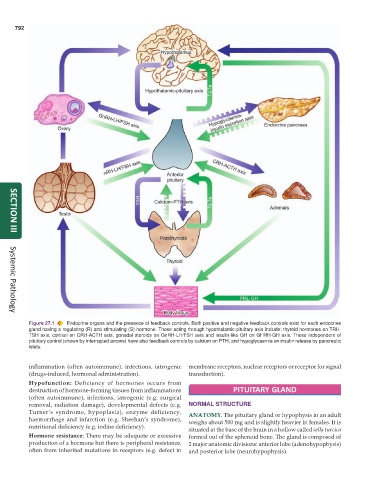
           Figure 27.1  Endocrine organs and the presence of feedback controls. Both positive and negative feedback controls exist for each endocrine
           gland having a regulating (R) and stimulating (S) hormone. Those acting through hypothalamic-pituitary axis include: thyroid hormones on TRH-
           TSH axis, cortisol on CRH-ACTH axis, gonadal steroids on GnRH-LH/FSH axis and insulin-like GH on GHRH-GH axis. Those independent of
           pituitary control (shown by interrupted arrows) have also feedback controls by calcium on PTH, and hypoglycaemia on insulin release by pancreatic
           islets.


           inflammation (often autoimmune), infections, iatrogenic  membrane receptors, nuclear receptors or receptor for signal
           (drugs-induced, hormonal administration).           transduction).
           Hypofunction:  Deficiency of hormones occurs from
           destruction of hormone-forming tissues from inflammations          PITUITARY GLAND
           (often autoimmune), infections, iatrogenic (e.g. surgical
           removal, radiation damage), developmental defects (e.g.  NORMAL STRUCTURE
           Turner’s syndrome, hypoplasia), enzyme deficiency,  ANATOMY. The pituitary gland or hypophysis in an adult
           haemorrhage and infarction (e.g. Sheehan’s syndrome),  weighs about 500 mg and is slightly heavier in females. It is
           nutritional deficiency (e.g. iodine deficiency).
                                                               situated at the base of the brain in a hollow called sella turcica
           Hormone resistance: There may be adequate or excessive  formed out of the sphenoid bone. The gland is composed of
           production of a hormone but there is peripheral resistance,  2 major anatomic divisions: anterior lobe (adenohypophysis)
           often from inherited mutations in receptors (e.g. defect in  and posterior lobe (neurohypophysis).

