


Page 803 - Textbook of Pathology, 6th Edition
P. 803
III.  MELANOCYTIC  TUMOURS                                                                               787
           Melanocytic tumours may arise from one of the three cell
           types: naevus cells, epidermal melanocytes and dermal
           melanocytes.
              Benign tumours originating from naevus cells are called
           naevocellular naevi.
              The examples of benign tumours arising from epidermal
           melanocytes are lentigo, freckles, pigmentation associated with
           Albright’s syndrome and  cafe-au-lait spots of neuro-
           fibromatosis (page 838).
              Benign tumours  derived from dermal melanocytes are
           Mongolian spots, naevi of Ota and of Ito and the blue naevus.
              Malignant melanoma is the malignant counterpart of
           melanocytic tumours.
              The important examples amongst these are described
           below.
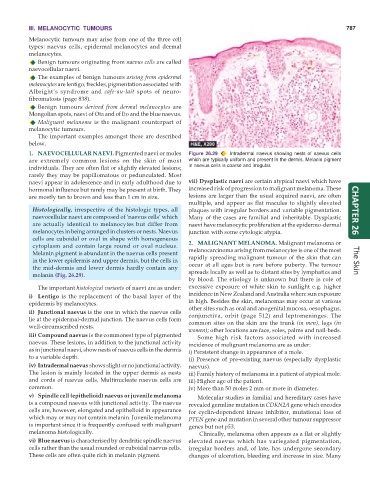
           1. NAEVOCELLULAR NAEVI. Pigmented naevi or moles    Figure 26.29  Intradermal naevus showing nests of naevus cells
           are extremely common lesions on the skin of most    which are typically uniform and present in the dermis. Melanin pigment
           individuals. They are often flat or slightly elevated lesions;  in naevus cells is coarse and irregular.
           rarely they may be papillomatous or pedunculated. Most
           naevi appear in adolescence and in early adulthood due to  vii) Dysplastic naevi are certain atypical naevi which have
           hormonal influence but rarely may be present at birth. They  increased risk of progression to malignant melanoma. These
           are mostly tan to brown and less than 1 cm in size.  lesions are larger than the usual acquired naevi, are often
                                                               multiple, and appear as flat macules to slightly elevated
            Histologically, irrespective of the histologic types, all  plaques with irregular borders and variable pigmentation.  CHAPTER 26
            naevocellular naevi are composed of ‘naevus cells’ which  Many of the cases are familial and inheritable. Dysplastic
            are actually identical to melanocytes but differ from  naevi have melanocytic proliferation at the epidermo-dermal
            melanocytes in being arranged in clusters or nests. Naevus  junction with some cytologic atypia.
            cells are cuboidal or oval in shape with homogeneous
            cytoplasm and contain large round or oval nucleus.  2. MALIGNANT MELANOMA. Malignant melanoma or
            Melanin pigment is abundant in the naevus cells present  melanocarcinoma arising from melanocytes is one of the most
            in the lower epidermis and upper dermis, but the cells in  rapidly spreading malignant tumour of the skin that can  The Skin
            the mid-dermis and lower dermis hardly contain any  occur at all ages but is rare before puberty. The tumour
            melanin (Fig. 26.29).                              spreads locally as well as to distant sites by lymphatics and
                                                               by blood. The etiology is unknown but there is role of
              The important histological variants of naevi are as under:  excessive exposure of white skin to sunlight e.g. higher
           i) Lentigo is the replacement of the basal layer of the  incidence in New Zealand and Australia where sun exposure
           epidermis by melanocytes.                           in high. Besides the skin, melanomas may occur at various
           ii) Junctional naevus is the one in which the naevus cells  other sites such as oral and anogenital mucosa, oesophagus,
                                                               conjunctiva, orbit (page 512) and leptomeninges. The
           lie at the epidermal-dermal junction. The naevus cells form
           well-circumscribed nests.                           common sites on the skin are the trunk (in men),  legs (in
                                                               women); other locations are face, soles, palms and nail-beds.
           iii) Compound naevus is the commonest type of pigmented  Some high risk factors associated with increased
           naevus. These lesions, in addition to the junctional activity  incidence of malignant melanoma are as under:
           as in junctional naevi, show nests of naevus cells in the dermis  i) Persistent change in appearance of a mole.
           to a variable depth.                                ii) Presence of pre-existing naevus (especially dysplastic
           iv) Intradermal naevus shows slight or no junctional activity.  naevus).
           The lesion is mainly located in the upper dermis as nests  iii) Family history of melanoma in a patient of atypical mole.
           and cords of naevus cells. Multinucleate naevus cells are  iii) Higher age of the patient.
           common.                                             iv) More than 50 moles 2 mm or more in diameter.
           v) Spindle cell (epithelioid) naevus or juvenile melanoma  Molecular studies in familial and hereditary cases have
           is a compound naevus with junctional activity. The naevus  revealed germline mutation in CDKN2A gene which encodes
           cells are, however, elongated and epithelioid in appearance  for cyclin-dependent kinase inhibitor, mutational loss of
           which may or may not contain melanin. Juvenile melanoma  PTEN gene and mutation in several other tumour suppressor
           is important since it is frequently confused with malignant  genes but not p53.
           melanoma histologically.                                Clinically, melanoma often appears as a flat or slightly
           vi) Blue naevus is characterised by dendritic spindle naevus  elevated naevus which has variegated pigmentation,
           cells rather than the usual rounded or cuboidal naevus cells.  irregular borders and, of late, has undergone secondary
           These cells are often quite rich in melanin pigment.  changes of ulceration, bleeding and increase in size. Many

