


Page 823 - Textbook of Pathology, 6th Edition
P. 823
administration results in accumulation of colloid in the                                                 807
           follicles and decrease in vascularity and height of follicular
           cells, while antithyroid drugs such as thiouracil cause marked
           hyperplasia.
           CLINICAL FEATURES. Graves’ disease generally develops
           slowly and insidiously.
              Patients are usually young women who present with
           symmetric, moderate enlargement of the thyroid gland with
           features of thyrotoxicosis (page 802), ophthalmopathy and
           dermatopathy.
              Ocular abnormalities are lid lag, upper lid retraction, stare,
           weakness of eye muscles and proptosis. In extreme cases,
           the lids can no longer close and may produce corneal injuries
           and ulcerations.
              Dermatopathy in Graves’ disease most often consists of
           pretibial (localised) myxoedema in the form of firm plaques.
              Like in Hashimoto’s thyroiditis, there is no increased risk
           of development of thyroid cancer in Graves’ disease.

           GOITRE
           The term goitre is defined as thyroid enlargement caused by
           compensatory hyperplasia and hypertrophy of the follicular
           epithelium in response to thyroid hormone deficiency. The
           end-result of this hyperplasia is generally a euthyroid state
           (in contrast to thyrotoxicosis occurring in diffuse toxic goitre                                           CHAPTER 27
           or Graves’ disease) though at some stages there may be hypo-
           or hyperthyroidism. Two morphologic forms of goitre are
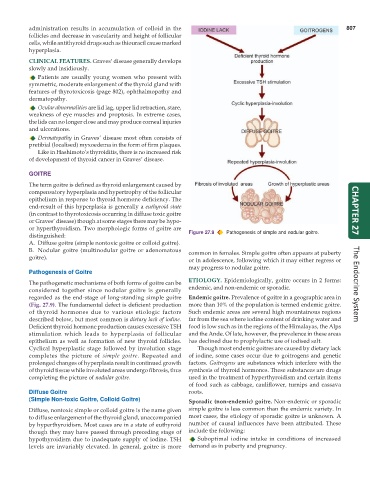
           distinguished:                                      Figure 27.9  Pathogenesis of simple and nodular goitre.
           A. Diffuse goitre (simple nontoxic goitre or colloid goitre).
           B. Nodular goitre (multinodular goitre or adenomatous  common in females. Simple goitre often appears at puberty
           goitre).                                            or in adolescence, following which it may either regress or
                                                               may progress to nodular goitre.
           Pathogenesis of Goitre

           The pathogenetic mechanisms of both forms of goitre can be  ETIOLOGY.  Epidemiologically, goitre occurs in 2 forms:  The Endocrine System
           considered together since nodular goitre is generally  endemic, and non-endemic or sporadic.
           regarded as the end-stage of long-standing simple goitre  Endemic goitre. Prevalence of goitre in a geographic area in
           (Fig. 27.9). The fundamental defect is deficient production  more than 10% of the population is termed endemic goitre.
           of thyroid hormones due to various etiologic factors  Such endemic areas are several high mountainous regions
           described below, but most common is dietary lack of iodine.  far from the sea where iodine content of drinking water and
           Deficient thyroid hormone production causes excessive TSH  food is low such as in the regions of the Himalayas, the Alps
           stimulation which leads to hyperplasia of follicular  and the Ande. Of late, however, the prevalence in these areas
           epithelium as well as formation of new thyroid follicles.  has declined due to prophylactic use of iodised salt.
           Cyclical hyperplastic stage followed by involution stage  Though most endemic goitres are caused by dietary lack
           completes the picture of  simple goitre. Repeated and  of iodine, some cases occur due to goitrogens and genetic
           prolonged changes of hyperplasia result in continued growth  factors. Goitrogens are substances which interfere with the
           of thyroid tissue while involuted areas undergo fibrosis, thus  synthesis of thyroid hormones. These substances are drugs
           completing the picture of nodular goitre.           used in the treatment of hyperthyroidism and certain items
                                                               of food such as cabbage, cauliflower, turnips and cassava
           Diffuse Goitre                                      roots.
           (Simple Non-toxic Goitre, Colloid Goitre)           Sporadic (non-endemic) goitre. Non-endemic or sporadic
           Diffuse, nontoxic simple or colloid goitre is the name given  simple goitre is less common than the endemic variety. In
           to diffuse enlargement of the thyroid gland, unaccompanied  most cases, the etiology of sporadic goitre is unknown. A
           by hyperthyroidism. Most cases are in a state of euthyroid  number of causal influences have been attributed. These
           though they may have passed through preceding stage of  include the following:
           hypothyroidism due to inadequate supply of iodine. TSH  Suboptimal iodine intake in conditions of increased
           levels are invariably elevated. In general, goitre is more  demand as in puberty and pregnancy.

