


Page 88 - Textbook of Pathology, 6th Edition
P. 88
72


     SECTION I


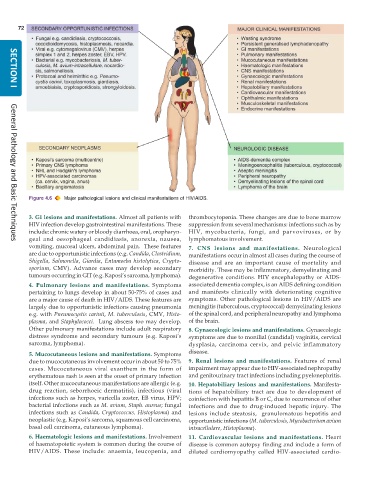
           Figure 4.6  Major pathological lesions and clinical manifestations of HIV/AIDS.


           3. GI lesions and manifestations. Almost all patients with  thrombocytopenia. These changes are due to bone marrow
           HIV infection develop gastrointestinal manifestations. These  suppression from several mechanisms: infections such as by
           include: chronic watery or bloody diarrhoea, oral, oropharyn-  HIV, mycobacteria, fungi, and parvoviruses, or by
           geal and oesophageal candidiasis, anorexia, nausea,  lymphomatous involvement.
     General Pathology and Basic Techniques
           vomiting, mucosal ulcers, abdominal pain.  These features  7. CNS lesions and manifestations.  Neurological
           are due to opportunistic infections (e.g. Candida, Clostridium,  manifestations occur in almost all cases during the course of
           Shigella,  Salmonella, Giardia,  Entamoeba histolytica, Crypto-  disease and are an important cause of mortality and
           sporium, CMV). Advance cases may develop secondary  morbidity. These may be inflammatory, demyelinating and
           tumours occurring in GIT (e.g. Kaposi’s sarcoma, lymphoma).  degenerative conditions. HIV encephalopathy or AIDS-
           4. Pulmonary lesions and manifestations.  Symptoms  associated dementia complex, is an AIDS defining condition
           pertaining to lungs develop in about 50-75% of cases and  and manifests clinically with deteriorating cognitive
           are a major cause of death in HIV/AIDS. These features are  symptoms. Other pathological lesions in HIV/AIDS are
           largely due to opportunistic infections causing pneumonia  meningitis (tuberculous, cryptococcal) demyelinating lesions
           e.g. with Pneumocystis carinii, M. tuberculosis, CMV, Histo-  of the spinal cord, and peripheral neuropathy and lymphoma
           plasma, and Staphylococci.  Lung abscess too may develop.  of the brain.
           Other pulmonary manifestations include adult respiratory  8. Gynaecologic lesions and manifestations. Gynaecologic
           distress syndrome and secondary tumours (e.g. Kaposi’s  symptoms are due to monilial (candidal) vaginitis, cervical
           sarcoma, lymphoma).                                 dysplasia, carcinoma cervix, and pelvic inflammatory
           5. Mucocutaneous lesions and manifestations. Symptoms  disease.
           due to mucocutaneous involvement occur in about 50 to 75%  9. Renal lesions and manifestations.  Features of renal
           cases. Mucocutaneous viral exanthem in the form of  impairment may appear due to HIV-associated nephropathy
           erythematous rash is seen at the onset of primary infection  and genitourinary tract infections including pyelonephritis.
           itself. Other mucocutaneous manifestations are allergic (e.g.  10. Hepatobiliary lesions and manifestations. Manifesta-
           drug reaction, seborrhoeic dermatitis), infectious (viral  tions of hepatobiliary tract are due to development of
           infections such as herpes, varicella zoster, EB virus, HPV;  coinfection with hepatitis B or C, due to occurrence of other
           bacterial infections such as M. avium, Staph. aureus; fungal  infections and due to drug-induced hepatic injury. The
           infections such as  Candida, Cryptococcus, Histoplasma) and  lesions include steatosis,  granulomatous hepatitis and
           neoplastic (e.g. Kaposi’s sarcoma, squamous cell carcinoma,  opportunistic infections (M. tuberculosis, Mycobacterium avium
           basal cell carcinoma, cutaneous lymphoma).          intracellulare, Histoplasma).
           6. Haematologic lesions and manifestations. Involvement  11. Cardiovascular lesions and manifestations.  Heart
           of haematopoietic system is common during the course of  disease is common autopsy finding and include a form of
           HIV/AIDS. These include: anaemia, leucopenia, and   dilated cardiomyopathy called HIV-associated cardio-

