


Page 86 - Textbook of Pathology, 6th Edition
P. 86
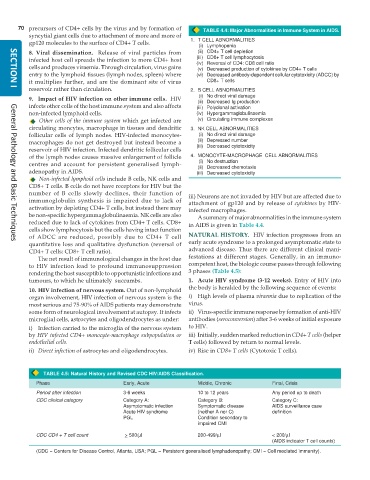
70 precursors of CD4+ cells by the virus and by formation of TABLE 4.4: Major Abnormalities in Immune System in AIDS.
syncytial giant cells due to attachment of more and more of
gp120 molecules to the surface of CD4+ T cells. 1. T CELL ABNORMALITIES
(i) Lymphopenia
8. Viral dissemination. Release of viral particles from (ii) CD4+ T cell depletion
infected host cell spreads the infection to more CD4+ host (iii) CD8+ T cell lymphocytosis
(iv) Reversal of CD4: CD8 cell ratio
cells and produces viraemia. Through circulation, virus gains (v) Decreased production of cytokines by CD4+ T cells
entry to the lymphoid tissues (lymph nodes, spleen) where (vi) Decreased antibody-dependent cellular cytotoxicity (ADCC) by
it multiplies further, and are the dominant site of virus CD8+ T cells
reservoir rather than circulation. 2. B CELL ABNORMALITIES
SECTION I
(i) No direct viral damage
9. Impact of HIV infection on other immune cells. HIV (ii) Decreased Ig production
infects other cells of the host immune system and also affects (iii) Polyclonal activation
non-infected lymphoid cells. (iv) Hypergammaglobulinaemia
Other cells of the immune system which get infected are (v) Circulating immune complexes
circulating moncytes, macrophage in tissues and dendritic 3. NK CELL ABNORMALITIES
follicular cells of lymph nodes. HIV-infected monocytes- (i) No direct viral damage
macrophages do not get destroyed but instead become a (ii) Depressed number
reservoir of HIV infection. Infected dendritic follicular cells (iii) Decreased cytotoxicity
of the lymph nodes causes massive enlargement of follicle 4. MONOCYTE-MACROPHAGE CELL ABNORMALITIES
(i) No destruction
centres and account for persistent generalised lymph- (ii) Decreased chemotaxis
adenopathy in AIDS. (iii) Decreased cytotoxicity
Non-infected lymphoid cells include B cells, NK cells and
CD8+ T cells. B cells do not have receptors for HIV but the
number of B cells slowly declines, their function of iii) Neurons are not invaded by HIV but are affected due to
immunoglobulin synthesis is impaired due to lack of attachment of gp120 and by release of cytokines by HIV-
activation by depleting CD4+ T cells, but instead there may infected macrophages.
be non-specific hypergammaglobulinaemia. NK cells are also A summary of major abnormalities in the immune system
reduced due to lack of cytokines from CD4+ T cells. CD8+ in AIDS is given in Table 4.4.
cells show lymphocytosis but the cells having intact function
of ADCC are reduced, possibly due to CD4+ T cell NATURAL HISTORY. HIV infection progresses from an
quantitative loss and qualitative dysfunction (reversal of early acute syndrome to a prolonged asymptomatic state to
General Pathology and Basic Techniques
CD4+ T cells: CD8+ T cell ratio). advanced disease. Thus there are different clinical mani-
The net result of immunological changes in the host due festations at different stages. Generally, in an immuno-
to HIV infection lead to profound immunosuppression competent host, the biologic course passes through following
rendering the host susceptible to opportunistic infections and 3 phases (Table 4.5):
tumours, to which he ultimately succumbs. 1. Acute HIV syndrome (3-12 weeks). Entry of HIV into
10. HIV infection of nervous system. Out of non-lymphoid the body is heralded by the following sequence of events:
organ involvement, HIV infection of nervous system is the i) High levels of plasma viraemia due to replication of the
most serious and 75-90% of AIDS patients may demonstrate virus.
some form of neurological involvement at autopsy. It infects ii) Virus-specific immune response by formation of anti-HIV
microglial cells, astrocytes and oligodendrocytes as under: antibodies (seroconversion) after 3-6 weeks of initial exposure
i) Infection carried to the microglia of the nervous system to HIV.
by HIV infected CD4+ monocyte-macrophage subpopulation or iii) Initially, sudden marked reduction in CD4+ T cells (helper
endothelial cells. T cells) followed by return to normal levels.
ii) Direct infection of astrocytes and oligodendrocytes. iv) Rise in CD8+ T cells (Cytotoxic T cells).
TABLE 4.5: Natural History and Revised CDC HIV/AIDS Classification.
Phase Early, Acute Middle, Chronic Final, Crisis
Period after infection 3-6 weeks 10 to 12 years Any period up to death
CDC clinical category Category A: Category B: Category C:
Asymptomatic infection Symptomatic disease AIDS surveillance case
Acute HIV syndrome (neither A nor C) definition
PGL Condition secondary to
impaired CMI
CDC CD4 + T cell count > 500/μl 200-499/μl < 200/μl
(AIDS indicator T cell counts)
(CDC = Centers for Disease Control, Atlanta, USA; PGL = Persistent generalised lymphadenopathy; CMI = Cell mediated immunity).

