


Page 83 - Textbook of Pathology, 6th Edition
P. 83
IMMUNODEFICIENCY DISEASES understanding of this dreaded disease as regards its 67
epidemiology, etiology, immunology, pathogenesis, clinical
Failure or deficiency of immune system, which normally features and morphologic changes in various tissues and
plays a protective role against infections, manifests by
occurrence of repeated infections in an individual having organs of the body. But efforts at finding its definite treatment
immunodeficiency diseases. and a vaccine have not yielded success so far, and thus the
Traditionally, immunodeficiency diseases are classified prognosis remains grim. Hence the global attention is CHAPTER 4
into 2 types: presently focussed on preventive measures.
A. Primary immunodeficiencies are usually the result of genetic EPIDEMIOLOGY. Although AIDS was first described in the
or developmental abnormality of the immune system. US, the disease has now attained pandemic proportions
B. Secondary immunodeficiencies arise from acquired involving all continents. Presently, developing countries
suppression of the immune system. comprise majority of cases and Africa alone constitutes 50%
Since the first description of primary immunodeficiency of all positive cases globally. According to a rough estimate,
by Bruton in 1952, an increasing number of primary and 1 in every 100 sexually active adults worldwide is infected
secondary immunodeficiency syndromes are being added with HIV. Half of all serologically positive cases are in women
to the list, the latest addition being the acquired immuno- while children comprise 5% of all cases. According to the
deficiency syndrome (AIDS) in 1981. WHO data, the last decade has shown an alarming rise in
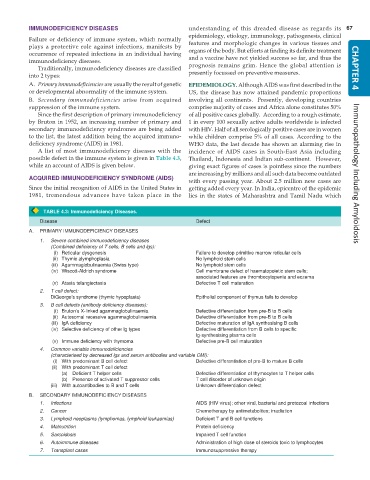
A list of most immunodeficiency diseases with the incidence of AIDS cases in South-East Asia including
possible defect in the immune system is given in Table 4.3, Thailand, Indonesia and Indian sub-continent. However,
while an account of AIDS is given below. giving exact figures of cases is pointless since the numbers
are increasing by millions and all such data become outdated Immunopathology Including Amyloidosis
ACQUIRED IMMUNODEFICIENCY SYNDROME (AIDS)
with every passing year. About 2.5 million new cases are
Since the initial recognition of AIDS in the United States in getting added every year. In India, epicentre of the epidemic
1981, tremendous advances have taken place in the lies in the states of Maharashtra and Tamil Nadu which
TABLE 4.3: lmmunodeficiency Diseases.
Disease Defect
A. PRIMARY IMMUNODEFICIENCY DISEASES
1. Severe combined immunodeficiency diseases
(Combined deficiency of T cells, B cells and lgs):
(i) Reticular dysgenesis Failure to develop primitive marrow reticular cells
(ii) Thymic alymphoplasia No lymphoid stem cells
(iii) Agammaglobulinaemia (Swiss type) No lymphoid stem cells
(iv) Wiscott-Aldrich syndrome Cell membrane defect of haematopoietic stem cells;
associated features are thrombocytopenia and eczema
(v) Ataxia telangiectasia Defective T cell maturation
2. T cell defect:
DiGeorge’s syndrome (thymic hypoplasia) Epithelial component of thymus fails to develop
3. B cell defects (antibody deficiency diseases):
(i) Bruton’s X-linked agammaglobulinaemia Defective differentiation from pre-B to B cells
(ii) Autosomal recessive agammaglobulinaemia Defective differentiation from pre-B to B cells
(iii) IgA deficiency Defective maturation of IgA synthesising B cells
(iv) Selective deficiency of other lg types Defective differentiation from B cells to specific
Ig-synthesising plasma cells
(v) Immune deficiency with thymoma Defective pre-B cell maturation
4. Common variable immunodeficiencies
(characterised by decreased lgs and serum antibodies and variable CMI):
(i) With predominant B cell defect Defective differentiation of pre-B to mature B cells
(ii) With predominant T cell defect
(a) Deficient T helper cells Defective differentiation of thymocytes to T helper cells
(b) Presence of activated T suppressor cells T cell disorder of unknown origin
(iii) With autoantibodies to B and T cells Unknown differentiation defect
B. SECONDARY IMMUNODEFICIENCY DISEASES
1. Infections AIDS (HIV virus); other viral, bacterial and protozoal infections
2. Cancer Chemotherapy by antimetabolites; irradiation
3. Lymphoid neoplasms (lymphomas, lymphoid leukaemias) Deficient T and B cell functions
4. Malnutrition Protein deficiency
5. Sarcoidosis Impaired T cell function
6. Autoimmune diseases Administration of high dose of steroids toxic to lymphocytes
7. Transplant cases Immunosuppressive therapy

