


Page 884 - Textbook of Pathology, 6th Edition
P. 884
868


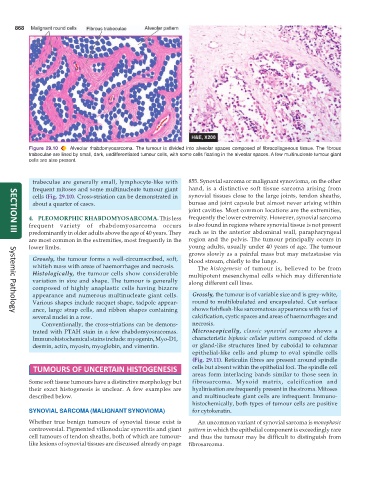
           Figure 29.10  Alveolar rhabdomyosarcoma. The tumour is divided into alveolar spaces composed of fibrocollagenous tissue. The fibrous
           trabeculae are lined by small, dark, undifferentiated tumour cells, with some cells floating in the alveolar spaces. A few multinucleate tumour giant
           cells are also present.


            trabeculae are generally small, lymphocyte-like with  855. Synovial sarcoma or malignant synovioma, on the other
            frequent mitoses and some multinucleate tumour giant  hand, is a distinctive soft tissue sarcoma arising from
            cells (Fig. 29.10). Cross-striation can be demonstrated in  synovial tissues close to the large joints, tendon sheaths,
            about a quarter of cases.                          bursae and joint capsule but almost never arising within
                                                               joint cavities. Most common locations are the extremities,
           4. PLEOMORPHIC RHABDOMYOSARCOMA. This less          frequently the lower extremity. However, synovial sarcoma
           frequent variety of rhabdomyosarcoma occurs         is also found in regions where synovial tissue is not present
           predominantly in older adults above the age of 40 years. They  such as in the anterior abdominal wall, parapharyngeal
     SECTION III
           are most common in the extremities, most frequently in the  region and the pelvis. The tumour principally occurs in
           lower limbs.                                        young adults, usually under 40 years of age. The tumour
                                                               grows slowly as a painful mass but may metastasise via
            Grossly, the tumour forms a well-circumscribed, soft,  blood stream, chiefly to the lungs.
            whitish mass with areas of haemorrhages and necrosis.  The  histogenesis of tumour is, believed to be from
            Histologically,  the tumour cells show considerable  multipotent mesenchymal cells which may differentiate
            variation in size and shape. The tumour is generally  along different cell lines.
            composed of highly anaplastic cells having bizarre
            appearance and numerous multinucleate giant cells.   Grossly, the tumour is of variable size and is grey-white,
            Various shapes include racquet shape, tadpole appear-  round to multilobulated and encapsulated. Cut surface
            ance, large strap cells, and ribbon shapes containing  shows fishflesh-like sarcomatous appearance with foci of
     Systemic Pathology
            several nuclei in a row.                             calcification, cystic spaces and areas of haemorrhages and
               Conventionally, the cross-striations can be demons-  necrosis.
            trated with PTAH stain in a few rhabdomyosracomas.   Microscopically,  classic synovial sarcoma shows a
            Immunohistochemical stains include: myogenin, Myo-D1,  characteristic biphasic cellular pattern composed of clefts
            desmin, actin, myosin, myoglobin, and vimentin.      or gland-like structures lined by cuboidal to columnar
                                                                 epithelial-like cells and plump to oval spindle cells
                                                                 (Fig. 29.11). Reticulin fibres are present around spindle
            TUMOURS OF UNCERTAIN HISTOGENESIS                    cells but absent within the epithelial foci. The spindle cell
                                                                 areas form interlacing bands similar to those seen in
           Some soft tissue tumours have a distinctive morphology but  fibrosarcoma. Myxoid matrix, calcification and
           their exact histogenesis is unclear. A few examples are  hyalinisation are frequently present in the stroma. Mitoses
           described below.                                      and multinucleate giant cells are infrequent. Immuno-
                                                                 histochemically, both types of tumour cells are positive
           SYNOVIAL SARCOMA (MALIGNANT SYNOVIOMA)                for cytokeratin.
           Whether true benign tumours of synovial tissue exist is  An uncommon variant of synovial sarcoma is monophasic
           controversial. Pigmented villonodular synovitis and giant  pattern in which the epithelial component is exceedingly rare
           cell tumours of tendon sheaths, both of which are tumour-  and thus the tumour may be difficult to distinguish from
           like lesions of synovial tissues are discussed already on page  fibrosarcoma.

