


Page 879 - Textbook of Pathology, 6th Edition
P. 879
blasts which have high mitotic rate. Ultrastructurally,                                                 863
            some of the fibroblasts have features of myofibroblasts
            having contractile nature. The palmar lesions frequently
            extend into soft tissues causing contractures. Both palmar
            and plantar lesions may remain stationary at nodular
            stage, progress, or regress spontaneously. Recurrence rate
            after surgical excision in both forms is as high as 50-60%.

           DESMOID FIBROMATOSES.  Desmoid fibromatoses or
           musculo-aponeurotic fibromatoses, commonly referred to as
           desmoid tumours, are of 2 types: abdominal and extra-
           abdominal. Both types are, however, histologically similar.
           Clinically, both types behave in an aggressive manner and
           have to be distinguished from sarcomas. Recurrences are
           frequent and multiple. The pathogenesis of these lesions is
           not known but among the factors implicated are the role of
           antecedent trauma, genetic influences and relationship to
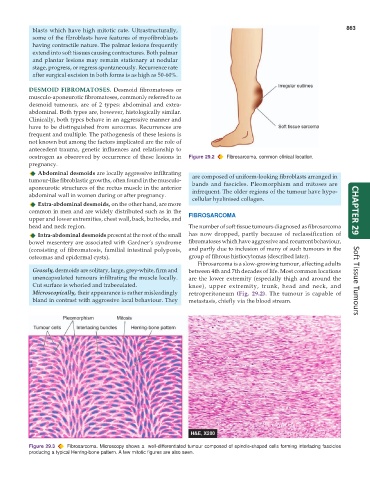
           oestrogen as obsereved by occurrence of these lesions in  Figure 29.2  Fibrosarcoma, common clinical location.
           pregnancy.
              Abdominal desmoids are locally aggressive infiltrating  are composed of uniform-looking fibroblasts arranged in
           tumour-like fibroblastic growths, often found in the musculo-  bands and fascicles. Pleomorphism and mitoses are
           aponeurotic structures of the rectus muscle in the anterior  infrequent. The older regions of the tumour have hypo-
           abdominal wall in women during or after pregnancy.
                                                                 cellular hyalinised collagen.
              Extra-abdominal desmoids, on the other hand, are more
           common in men and are widely distributed such as in the                                                    CHAPTER 29
           upper and lower extremities, chest wall, back, buttocks, and  FIBROSARCOMA
           head and neck region.                               The number of soft tissue tumours diagnosed as fibrosarcoma
              Intra-abdominal desmoids present at the root of the small  has now dropped, partly because of reclassification of
           bowel mesentery are associated with Gardner’s syndrome  fibromatoses which have aggressive and recurrent behaviour,
           (consisting of fibromatosis, familial intestinal polyposis,  and partly due to inclusion of many of such tumours in the
           osteomas and epidermal cysts).                      group of fibrous histiocytomas (described later).
                                                                  Fibrosarcoma is a slow-growing tumour, affecting adults
            Grossly, desmoids are solitary, large, grey-white, firm and  between 4th and 7th decades of life. Most common locations
            unencapsulated tumours infiltrating the muscle locally.  are the lower extremity (especially thigh and around the
            Cut surface is whorled and trabeculated.           knee), upper extremity, trunk, head and neck, and      Soft Tissue Tumours
            Microscopically, their appearance is rather misleadingly  retroperitoneum  (Fig. 29.2). The tumour is capable of
            bland in contrast with aggressive local behaviour. They  metastasis, chiefly via the blood stream.


           Figure 29.3  Fibrosarcoma. Microscopy shows a  well-differentiated tumour composed of spindle-shaped cells forming interlacing fascicles
           producing a typical Herring-bone pattern. A few mitotic figures are also seen.

