


Page 880 - Textbook of Pathology, 6th Edition
P. 880
864   Grossly, fibrosarcoma is a grey-white, firm, lobulated and
            characteristically circumscribed mass. Cut surface of the
            tumour is soft, fishflesh-like, with foci of necrosis and
            haemorrhages.
            Histologically, the tumour is composed of uniform,
            spindle-shaped fibroblasts arranged in intersecting
            fascicles. In well-differentiated tumours, such areas
            produce ‘herring-bone pattern’ (herring-bone is a sea fish)
            (Fig. 29.3). Poorly-differentiated fibrosarcoma, however,
            has highly pleomorphic appearance with frequent mitoses
            and bizarre cells.

                  FIBROHISTIOCYTIC  TUMOURS

           The group of fibrohistiocytic tumours is characterised by
           distinctive light microscopic features that include presence
           of cells with fibroblastic and histiocytic features in varying
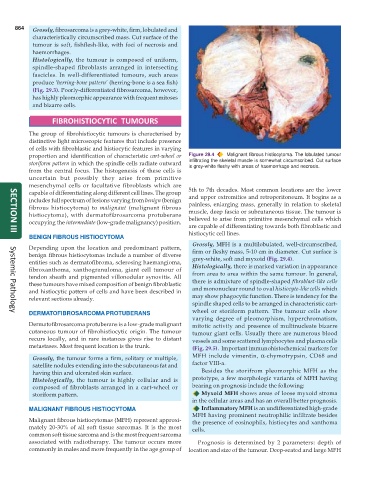
           proportion and identification of characteristic cart-wheel or  Figure 29.4  Malignant fibrous histiocytoma. The lobulated tumour
           storiform pattern in which the spindle cells radiate outward  infiltrating the skeletal muscle is somewhat circumscribed. Cut surface
                                                               is grey-white fleshy with areas of haemorrhage and necrosis.
           from the central focus. The histogenesis of these cells is
           uncertain but possibly they arise from primitive
           mesenchymal cells or facultative fibroblasts which are
           capable of differentiating along different cell lines. The group  5th to 7th decades. Most common locations are the lower
           includes full spectrum of lesions varying from benign (benign  and upper extremities and retroperitoneum. It begins as a
                                                               painless, enlarging mass, generally in relation to skeletal
           fibrous histiocytoma) to  malignant (malignant fibrous  muscle, deep fascia or subcutaneous tissue. The tumour is
           histiocytoma), with dermatofibrosarcoma protuberans  believed to arise from primitive mesenchymal cells which
           occupying the intermediate (low-grade malignancy) position.
                                                               are capable of differentiating towards both fibroblastic and
                                                               histiocytic cell lines.
     SECTION III
           BENIGN FIBROUS HISTIOCYTOMA
                                                                 Grossly, MFH is a multilobulated, well-circumscribed,
           Depending upon the location and predominant pattern,  firm or fleshy mass, 5-10 cm in diameter. Cut surface is
           benign fibrous histiocytomas include a number of diverse  grey-white, soft and myxoid (Fig. 29.4).
           entities such as dermatofibroma, sclerosing haemangioma,  Histologically, there is marked variation in appearance
           fibroxanthoma, xanthogranuloma, giant cell tumour of
           tendon sheath and pigmented villonodular synovitis. All  from area to area within the same tumour. In general,
           these tumours have mixed composition of benign fibroblastic  there is admixture of spindle-shaped fibroblast-like cells
           and histiocytic pattern of cells and have been described in  and mononuclear round to oval histiocyte-like cells which
           relevant sections already.                            may show phagocytic function. There is tendency for the
                                                                 spindle shaped cells to be arranged in characteristic cart-
           DERMATOFIBROSARCOMA PROTUBERANS                       wheel or storiform pattern. The tumour cells show
     Systemic Pathology
                                                                 varying degree of pleomorphism, hyperchromatism,
           Dermatofibrosarcoma protuberans is a low-grade malignant  mitotic activity and presence of multinucleate bizarre
           cutaneous tumour of fibrohistiocytic origin. The tumour  tumour giant cells. Usually there are numerous blood
           recurs locally, and in rare instances gives rise to distant  vessels and some scattered lymphocytes and plasma cells
           metastases. Most frequent location is the trunk.      (Fig. 29.5).  Important immunohistochemical markers for
            Grossly, the tumour forms a firm, solitary or multiple,  MFH include vimentin,  α-chymotrypsin, CD68 and
            satellite nodules extending into the subcutaneous fat and  factor VIII-a.
            having thin and ulcerated skin surface.                 Besides the storifrom pleomorphic MFH as the
            Histologically, the tumour is highly cellular and is  prototype, a few morphologic variants of MFH having
            composed of fibroblasts arranged in a cart-wheel or  bearing on prognosis include the following:
            storiform pattern.                                      Myxoid MFH shows areas of loose myxoid stroma
                                                                 in the cellular areas and has an overall better prognosis.
           MALIGNANT FIBROUS HISTIOCYTOMA                           Inflammatory MFH is an undifferentiated high-grade
                                                                 MFH having prominent neutrophilic infiltrate besides
           Malignant fibrous histiocytomas (MFH) represent approxi-  the presence of eosinophils, histiocytes and xanthoma
           mately 20-30% of all soft tissue sarcomas. It is the most  cells.
           common soft tissue sarcoma and is the most frequent sarcoma
           associated with radiotherapy. The tumour occurs more   Prognosis is determined by 2 parameters: depth of
           commonly in males and more frequently in the age group of  location and size of the tumour. Deep-seated and large MFH

