


Page 882 - Textbook of Pathology, 6th Edition
P. 882
866


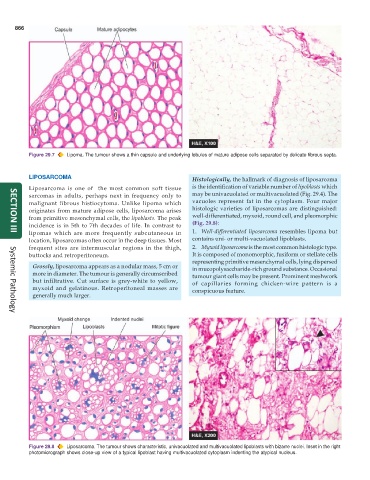
           Figure 29.7  Lipoma. The tumour shows a thin capsule and underlying lobules of mature adipose cells separated by delicate fibrous septa.


           LIPOSARCOMA                                           Histologically, the hallmark of diagnosis of liposarcoma
           Liposarcoma is one of  the most common soft tissue    is the identification of variable number of lipoblasts which
           sarcomas in adults, perhaps next in frequency only to  may be univacuolated or multivacuolated (Fig. 29.4). The
           malignant fibrous histiocytoma. Unlike lipoma which   vacuoles represent fat in the cytoplasm. Four major
           originates from mature adipose cells, liposarcoma arises  histologic varieties of liposarcomas are distinguished:
           from primitive mesenchymal cells, the lipoblasts. The peak  well-differentiated, myxoid, round cell, and pleomorphic
           incidence is in 5th to 7th decades of life. In contrast to  (Fig. 29.8):
           lipomas which are more frequently subcutaneous in     1. Well-differentiated liposarcoma resembles lipoma but
     SECTION III
           location, liposarcomas often occur in the deep tissues. Most  contains uni- or multi-vacuolated lipoblasts.
           frequent sites are intermuscular regions in the thigh,  2. Myxoid liposarcoma is the most common histologic type.
           buttocks and retroperitoneum.                         It is composed of monomorphic, fusiform or stellate cells
                                                                 representing primitive mesenchymal cells, lying dispersed
            Grossly, liposarcoma appears as a nodular mass, 5 cm or  in mucopolysaccharide-rich ground substance. Occasional
            more in diameter. The tumour is generally circumscribed  tumour giant cells may be present. Prominent meshwork
            but infiltrative. Cut surface is grey-white to yellow,  of capillaries forming chicken-wire pattern is a
            myxoid and gelatinous. Retroperitoneal masses are    conspicuous feature.
            generally much larger.


     Systemic Pathology


           Figure 29.8  Liposarcoma. The tumour shows characteristic, univacuolated and multivacuolated lipoblasts with bizarre nuclei. Inset in the right
           photomicrograph shows close-up view of a typical lipoblast having multivacuolated cytoplasm indenting the atypical nucleus.

