


Page 883 - Textbook of Pathology, 6th Edition
P. 883
3. Round cell liposarcoma is composed of uniform, round  Histologically, the tumour cells have resemblance to  867
            to oval cells having fine multivacuolated cytoplasm with  embryonal stage of development of muscle fibres. There
            central hyperchromatic nuclei. Round cell liposarcoma  is considerable variation in cell types. Generally, the
            may resemble a signet-ring carcinoma but mucin stains  tumour consists of a mixture of small, round to oval cells
            help in distinguishing the two.                      and spindle-shaped strap cells having tapering bipolar
            4. Pleomorphic liposarcoma is highly undifferentiated and  cytoplasmic processes in which cross-striations may be
            the most anaplastic type. There are numerous large   evident. The tumour cells form broad fascicles or bands.
            tumour giant cells and bizarre lipoblasts.           Mitoses are frequent.
              The prognosis of liposarcoma depends upon the location  2. BOTRYOID RHABDOMYOSARCOMA.  Botryoid
           and histologic type. In general, well-differentiated and  variety is regarded as a variant of embryonal rhabdomyo-
           myxoid varieties have excellent prognosis, while    sarcoma occurring in children under 10 years of age. It is
           pleomorphic liposarcoma has significantly poorer prognosis.  seen most frequently in the vagina, urinary bladder and nose
           Round cell and pleomorphic variants metastasise frequently  (page 724).
           to the lungs, other visceral organs and serosal surfaces.
                                                                 Grossly, the tumour forms a distinctive grape-like
                   SKELETAL MUSCLE  TUMOURS                      gelatinous mass protruding into the hollow cavity.
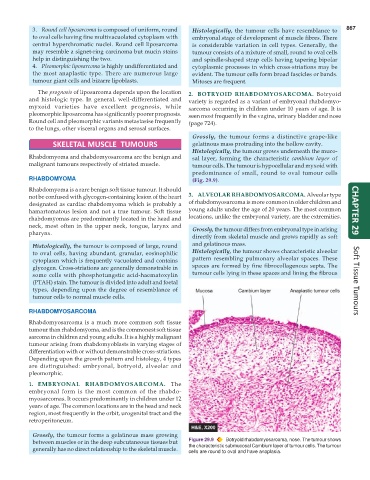
                                                                 Histologically, the tumour grows underneath the muco-
           Rhabdomyoma and rhabdomyosarcoma are the benign and   sal layer, forming the characteristic  cambium  layer  of
           malignant tumours respectively of striated muscle.    tumour cells. The tumour is hypocellular and myxoid with
                                                                 predominance of small, round to oval tumour cells
           RHABDOMYOMA                                           (Fig. 29.9).
           Rhabdomyoma is a rare benign soft tissue tumour. It should
           not be confused with glycogen-containing lesion of the heart  3. ALVEOLAR RHABDOMYOSARCOMA. Alveolar type
           designated as cardiac rhabdomyoma which is probably a  of rhabdomyosarcoma is more common in older children and
           hamartomatous lesion and not a true tumour. Soft tissue  young adults under the age of 20 years. The most common  CHAPTER 29
           rhabdomyomas are predominantly located in the head and  locations, unlike the embryonal variety, are the extremities.
           neck, most often in the upper neck, tongue, larynx and  Grossly, the tumour differs from embryonal type in arising
           pharynx.
                                                                 directly from skeletal muscle and grows rapidly as soft
            Histologically, the tumour is composed of large, round  and gelatinous mass.
            to oval cells, having abundant, granular, eosinophilic  Histologically, the tumour shows characteristic alveolar
            cytoplasm which is frequently vacuolated and contains  pattern resembling pulmonary alveolar spaces. These
            glycogen. Cross-striations are generally demonstrable in  spaces are formed by fine fibrocollagenous septa. The
            some cells with phosphotungstic acid-haematoxylin    tumour cells lying in these spaces and lining the fibrous
            (PTAH) stain. The tumour is divided into adult and foetal                                                 Soft Tissue Tumours
            types, depending upon the degree of resemblance of
            tumour cells to normal muscle cells.


           RHABDOMYOSARCOMA
           Rhabdomyosarcoma is a much more common soft tissue
           tumour than rhabdomyoma, and is the commonest soft tissue
           sarcoma in children and young adults. It is a highly malignant
           tumour arising from rhabdomyoblasts in varying stages of
           differentiation with or without demonstrable cross-striations.
           Depending upon the growth pattern and histology, 4 types
           are distinguished: embryonal, botryoid, alveolar and
           pleomorphic.
           1. EMBRYONAL RHABDOMYOSARCOMA.  The
           embryonal form is the most common of the rhabdo-
           myosarcomas. It occurs predominantly in children under 12
           years of age. The common locations are in the head and neck
           region, most frequently in the orbit, urogenital tract and the
           retroperitoneum.

            Grossly, the tumour forms a gelatinous mass growing
            between muscles or in the deep subcutaneous tissues but  Figure 29.9  Botryoid rhabdomyosarcoma, nose. The tumour shows
            generally has no direct relationship to the skeletal muscle.  the characteristic submucosal Cambium layer of tumour cells. The tumour
                                                               cells are round to oval and have anaplasia.

