


Page 898 - Textbook of Pathology, 6th Edition
P. 898
882   slit-like space called  apoplectic cyst  which contains  The remaining 15% cases of subarachnoid haemorrhage
            yellowish fluid. Its margins are yellow-brown and have  are the result of rupture in the posterior circulation, vascular
            haemosiderin-laden macrophages and a reactive zone of  malformations and rupture of mycotic aneurysms that occurs
            fibrillary astrocytosis.                           in the setting of bacterial endocarditis. In all types of
                                                               aneurysms, the rupture of thin-walled dilatation occurs in
           Subarachnoid Haemorrhage                            association with sudden rise in intravascular pressure but
           Haemorrhage into the subarachnoid space is most comm-  chronic hypertension does not appear to be a risk factor in
           only caused by rupture of an aneurysm, and rarely, rupture  their development or rupture.
           of a vascular malformation.                            Clinically, berry aneurysms remain asymptomatic prior
              A general discussion of aneurysms is given on page 405.  to rupture. On rupture, they produce severe generalised
           Of the three types of aneurysms affecting the larger  headache of sudden onset which is frequently followed by
                                                               unconsciousness and neurologic defects. Initial mortality
           intracranial arteries—berry, mycotic and fusiform, berry  from first rupture is about 20-25%. Survivors recover
           aneurysms are most important and most common.
                                                               completely but frequently suffer from recurrent episodes of
           BERRY ANEURYSMS  are saccular in appearance with    fresh bleeding.
           rounded or lobulated bulge arising at the bifurcation of
           intracranial arteries and varying in size from 2 mm to 2 cm  MORPHOLOGIC FEATURES. Rupture of a berry aneu-
           or more. They account for 95% of aneurysms which are liable  rysm frequently spreads haemorrhage throughout the
           to rupture. Berry aneurysms are rare in childhood but  subarachnoid space with rise in intracranial pressure and
           increase in frequency in young adults and middle life. They  characteristic blood-stained CSF. An intracerebral
           are, therefore, not congenital anomalies but develop over the  haematoma may develop if the blood tracks into the brain
           years from developmental defect of the media of the arterial  parenchyma. The region of the brain supplied by the
           wall at the bifurcation of arteries forming thin-walled saccu-  affected artery frequently shows infarction, partly
           lar bulges. Although most berry aneurysms are sporadic in  attributed to vasospasm.
           occurrence, there is an increased incidence of their presence
           in association with congenital polycystic kidney disease and  TRAUMA TO THE CNS
           coarctation of the aorta. About a quarter of berry aneurysms
           are multiple.                                       Trauma to the CNS constitutes an important cause of death
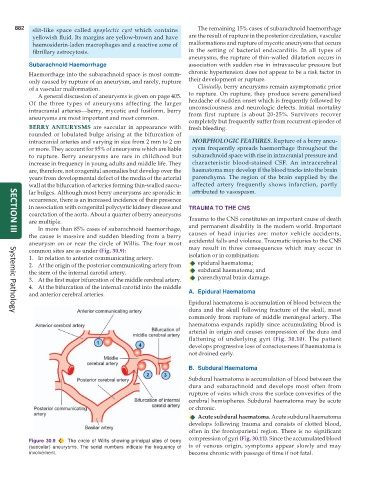
              In more than 85% cases of subarachnoid haemorrhage,  and permanent disability in the modern world. Important
           the cause is massive and sudden bleeding from a berry  causes of head injuries are: motor vehicle accidents,
     SECTION III
           aneurysm on or near the circle of Willis. The four most  accidental falls and violence. Traumatic injuries to the CNS
           common sites are as under (Fig. 30.9):              may result in three consequences which may occur in
           1. In relation to anterior communicating artery.    isolation or in combination:
           2. At the origin of the posterior communicating artery from  epidural haematoma;
           the stem of the internal carotid artery.               subdural haematoma; and
           3. At the first major bifurcation of the middle cerebral artery.  parenchymal brain damage.
           4. At the bifurcation of the internal carotid into the middle
           and anterior cerebral arteries.                     A. Epidural Haematoma
                                                               Epidural haematoma is accumulation of blood between the
                                                               dura and the skull following fracture of the skull, most
     Systemic Pathology
                                                               commonly from rupture of middle meningeal artery. The
                                                               haematoma expands rapidly since accumulating blood is
                                                               arterial in origin and causes compression of the dura and
                                                               flattening of underlying gyri  (Fig. 30.10). The patient
                                                               develops progressive loss of consciousness if haematoma is
                                                               not drained early.

                                                               B. Subdural Haematoma
                                                               Subdural haematoma is accumulation of blood between the
                                                               dura and subarachnoid and develops most often from
                                                               rupture of veins which cross the surface convexities of the
                                                               cerebral hemispheres. Subdural haematoma may be acute
                                                               or chronic.
                                                                  Acute subdural haematoma. Acute subdural haematoma
                                                               develops following trauma and consists of clotted blood,
                                                               often in the frontoparietal region. There is no significant
                                                               compression of gyri (Fig. 30.11). Since the accumulated blood
           Figure 30.9  The circle of Willis showing principal sites of berry
           (saccular) aneurysms. The serial numbers indicate the frequency of  is of venous origin, symptoms appear slowly and may
           involvement.                                        become chronic with passage of time if not fatal.

