


Page 897 - Textbook of Pathology, 6th Edition
P. 897
881


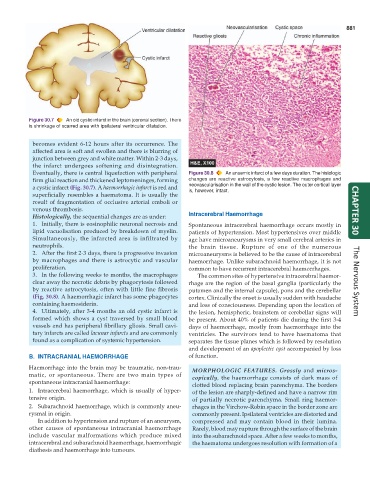
           Figure 30.7  An old cystic infarct in the brain (coronal section). There
           is shrinkage of scarred area with ipsilateral ventricular dilatation.


            becomes evident 6-12 hours after its occurrence. The
            affected area is soft and swollen and there is blurring of
            junction between grey and white matter. Within 2-3 days,
            the infarct undergoes softening and disintegration.
            Eventually, there is central liquefaction with peripheral  Figure 30.8  An anaemic infarct of a few days duration. The histologic
            firm glial reaction and thickened leptomeninges, forming  changes are reactive astrocytosis, a few reactive macrophages and
            a cystic infarct (Fig. 30.7). A haemorrhagic infarct is red and  neovascularisation in the wall of the cystic lesion. The outer cortical layer
            superficially resembles a haematoma. It is usually the  is, however, intact.
            result of fragmentation of occlusive arterial emboli or
            venous thrombosis.                                                                                        CHAPTER 30
            Histologically, the sequential changes are as under:  Intracerebral Haemorrhage
            1. Initially, there is eosinophilic neuronal necrosis and  Spontaneous intracerebral haemorrhage occurs mostly in
            lipid vacuolisation produced by breakdown of myelin.  patients of hypertension. Most hypertensives over middle
            Simultaneously, the infarcted area is infiltrated by  age have microaneurysms in very small cerebral arteries in
            neutrophils.                                       the brain tissue. Rupture of one of the numerous
            2. After the first 2-3 days, there is progressive invasion  microaneurysms is believed to be the cause of intracerebral
            by macrophages and there is astrocytic and vascular  haemorrhage. Unlike subarachnoid haemorrhage, it is not
            proliferation.                                     common to have recurrent intracerebral haemorrhages.
            3. In the following weeks to months, the macrophages  The common sites of hypertensive intracerebral haemor-
            clear away the necrotic debris by phagocytosis followed  rhage are the region of the basal ganglia (particularly the  The Nervous System
            by reactive astrocytosis, often with little fine fibrosis  putamen and the internal capsule), pons and the cerebellar
            (Fig. 30.8). A haemorrhagic infarct has some phagocytes  cortex. Clinically the onset is usually sudden with headache
            containing haemosiderin.                           and loss of consciousness. Depending upon the location of
            4. Ultimately, after 3-4 months an old cystic infarct is  the lesion, hemispheric, brainstem or cerebellar signs will
            formed which shows a cyst traversed by small blood  be present. About 40% of patients die during the first 3-4
            vessels and has peripheral fibrillary gliosis. Small cavi-  days of haemorrhage, mostly from haemorrhage into the
            tary infarcts are called lacunar infarcts and are commonly  ventricles. The survivors tend to have haematoma that
            found as a complication of systemic hypertension.  separates the tissue planes which is followed by resolution
                                                               and development of an apoplectic cyst accompanied by loss
           B. INTRACRANIAL HAEMORRHAGE                         of function.
           Haemorrhage into the brain may be traumatic, non-trau-  MORPHOLOGIC FEATURES. Grossly and  micros-
           matic, or spontaneous. There are two main types of    copically, the haemorrhage consists of dark mass of
           spontaneous intracranial haemorrhage:                 clotted blood replacing brain parenchyma. The borders
           1. Intracerebral haemorrhage, which is usually of hyper-  of the lesion are sharply-defined and have a narrow rim
           tensive origin.                                       of partially necrotic parenchyma. Small ring haemor-
           2. Subarachnoid haemorrhage, which is commonly aneu-  rhages in the Virchow-Robin space in the border zone are
           rysmal in origin.                                     commonly present. Ipsilateral ventricles are distorted and
              In addition to hypertension and rupture of an aneurysm,  compressed and may contain blood in their lumina.
           other causes of spontaneous intracranial haemorrhage  Rarely, blood may rupture through the surface of the brain
           include vascular malformations which produce mixed    into the subarachnoid space. After a few weeks to months,
           intracerebral and subarachnoid haemorrhage, haemorrhagic  the haematoma undergoes resolution with formation of a
           diathesis and haemorrhage into tumours.

