


Page 902 - Textbook of Pathology, 6th Edition
P. 902
886 Nutritional Diseases
Neurologic disorders may be caused by malnutrition from
lack of adequate diet in many developing countries and many
poor socio-economic groups. In the United States and Europe,
however, nutritionally-induced disease is chiefly found in
association with chronic alcoholism or due to defect in
absorption, transport or metabolism of dietary nutrients.
The general aspects of deficiency diseases have been
covered in Chapter 9. Some of the common neurologic
diseases included in the category of deficiency diseases are
as under:
1. Wernicke’s encephalopathy and Korsakoff’s psychosis
(vitamin B or thiamine deficiency).
1
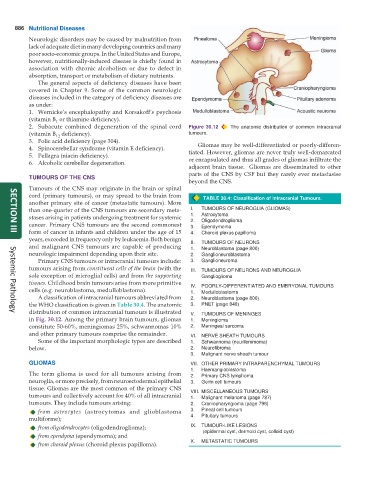
2. Subacute combined degeneration of the spinal cord Figure 30.12 The anatomic distribution of common intracranial
(vitamin B deficiency). tumours.
12
3. Folic acid deficiency (page 304). Gliomas may be well-differentiated or poorly-differen-
4. Spinocerebellar syndrome (vitamin E deficiency). tiated. However, gliomas are never truly well-demarcated
5. Pellagra (niacin deficiency). or encapsulated and thus all grades of gliomas infiltrate the
6. Alcoholic cerebellar degeneration.
adjacent brain tissue. Gliomas are disseminated to other
parts of the CNS by CSF but they rarely ever metastasise
TUMOURS OF THE CNS
beyond the CNS.
Tumours of the CNS may originate in the brain or spinal
cord (primary tumours), or may spread to the brain from TABLE 30.4: Classification of Intracranial Tumours.
another primary site of cancer (metastatic tumours). More
than one-quarter of the CNS tumours are secondary meta- I. TUMOURS OF NEUROGLIA (GLIOMAS)
stases arising in patients undergoing treatment for systemic 1. Astrocytoma
Oligodendroglioma
2.
cancer. Primary CNS tumours are the second commonest 3. Ependymoma
form of cancer in infants and children under the age of 15 4. Choroid plexus papilloma
SECTION III
years, exceeded in frequency only by leukaemia. Both benign II. TUMOURS OF NEURONS
and malignant CNS tumours are capable of producing 1. Neuroblastoma (page 800)
neurologic impairment depending upon their site. 2. Ganglioneuroblastoma
Primary CNS tumours or intracranial tumours include: 3. Ganglioneuroma
tumours arising from constituent cells of the brain (with the III. TUMOURS OF NEURONS AND NEUROGLIA
sole exception of microglial cells) and from the supporting Ganglioglioma
tissues. Childhood brain tumours arise from more primitive IV. POORLY-DIFFERENTIATED AND EMBRYONAL TUMOURS
cells (e.g. neuroblastoma, medulloblastoma). 1. Medulloblastoma
A classification of intracranial tumours abbreviated from 2. Neuroblastoma (page 800)
the WHO classification is given in Table 30.4. The anatomic 3. PNET (page 848)
distribution of common intracranial tumours is illustrated V. TUMOURS OF MENINGES
Systemic Pathology
in Fig. 30.12. Among the primary brain tumours, gliomas 1. Meningioma
constitute 50-60%, meningiomas 25%, schwannomas 10% 2. Meningeal sarcoma
and other primary tumours comprise the remainder. VI. NERVE SHEATH TUMOURS
Some of the important morphologic types are described 1. Schwannoma (neurilemmoma)
below. 2. Neurofibroma
3. Malignant nerve sheath tumour
GLIOMAS VII. OTHER PRIMARY INTRAPARENCHYMAL TUMOURS
1. Haemangioblastoma
The term glioma is used for all tumours arising from 2. Primary CNS lymphoma
neuroglia, or more precisely, from neuroectodermal epithelial 3. Germ cell tumours
tissue. Gliomas are the most common of the primary CNS VIII. MISCELLANEOUS TUMOURS
tumours and collectively account for 40% of all intracranial 1. Malignant melanoma (page 787)
tumours. They include tumours arising: 2. Craniopharyngioma (page 796)
from astrocytes (astrocytomas and glioblastoma 3. Pineal cell tumours
multiforme); 4. Pituitary tumours
from oligodendrocytes (oligodendroglioma); IX. TUMOUR-LIKE LESIONS
(epidermal cyst, dermoid cyst, colloid cyst)
from ependyma (ependymoma); and
from choroid plexus (choroid plexus papilloma). X. METASTATIC TUMOURS

