


Page 899 - Textbook of Pathology, 6th Edition
P. 899
883


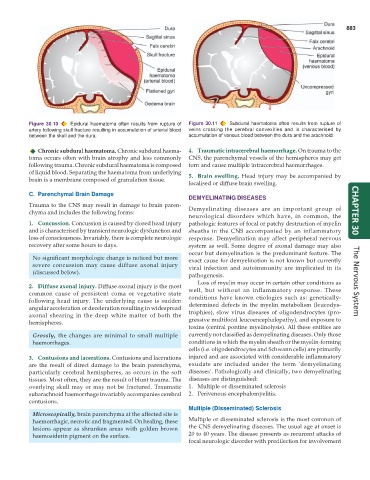
           Figure 30.10  Epidural haematoma often results from rupture of  Figure 30.11  Subdural haematoma often results from rupture of
           artery following skull fracture resulting in accumulation of arterial blood  veins crossing the cerebral convexities and is characterised by
           between the skull and the dura.                     accumulation of venous blood between the dura and the arachnoid.

              Chronic subdural haematoma. Chronic subdural haema-  4. Traumatic intracerebral haemorrhage. On trauma to the
           toma occurs often with brain atrophy and less commonly  CNS, the parenchymal vessels of the hemispheres may get
           following trauma. Chronic subdural haematoma is composed  torn and cause multiple intracerebral haemorrhages.
           of liquid blood. Separating the haematoma from underlying  5. Brain swelling.  Head injury may be accompanied by
           brain is a membrane composed of granulation tissue.
                                                               localised or diffuse brain swelling.
           C. Parenchymal Brain Damage
                                                               DEMYELINATING DISEASES
           Trauma to the CNS may result in damage to brain paren-  Demyelinating diseases are an important group of
           chyma and includes the following forms:                                                                    CHAPTER 30
                                                               neurological disorders which have, in common, the
           1. Concussion. Concussion is caused by closed head injury  pathologic features of focal or patchy destruction of myelin
           and is characterised by transient neurologic dysfunction and  sheaths in the CNS accompanied by an inflammatory
           loss of consciousness. Invariably, there is complete neurologic  response. Demyelination may affect peripheral nervous
           recovery after some hours to days.                  system as well. Some degree of axonal damage may also
                                                               occur but demyelination is the predominant feature. The
            No significant morphologic change is noticed but more  exact cause for demyelination is not known but currently
            severe concussion may cause diffuse axonal injury  viral infection and autoimmunity are implicated in its
            (discussed below).
                                                               pathogenesis.
                                                                  Loss of myelin may occur in certain other conditions as  The Nervous System
           2. Diffuse axonal injury. Diffuse axonal injury is the most
           common cause of persistent coma or vegetative state  well, but without an inflammatory response. These
           following head injury. The underlying cause is sudden  conditions have known etiologies such as: genetically-
           angular acceleration or deceleration resulting in widespread  determined defects in the myelin metabolism (leucodys-
           axonal shearing in the deep white matter of both the  trophies), slow virus diseases of oligodendrocytes (pro-
           hemispheres.                                        gressive multifocal leucoencephalopathy), and exposure to
                                                               toxins (central pontine myelinolysis). All these entities are
            Grossly, the changes are minimal to small multiple  currently not classified as demyelinating diseases. Only those
            haemorrhages.                                      conditions in which the myelin sheath or the myelin-forming
                                                               cells (i.e. oligodendrocytes and Schwann cells) are primarily
           3. Contusions and lacerations. Contusions and lacerations  injured and are associated with considerable inflammatory
           are the result of direct damage to the brain parenchyma,  exudate are included under the term ‘demyelinating
           particularly cerebral hemispheres, as occurs in the soft  diseases’. Pathologically and clinically, two demyelinating
           tissues. Most often, they are the result of blunt trauma. The  diseases are distinguished:
           overlying skull may or may not be fractured. Traumatic  1. Multiple or disseminated sclerosis
           subarachnoid haemorrhage invariably accompanies cerebral  2. Perivenous encephalomyelitis.
           contusions.
                                                               Multiple (Disseminated) Sclerosis
            Microscopically, brain parenchyma at the affected site is
            haemorrhagic, necrotic and fragmented. On healing, these  Multiple or disseminated sclerosis is the most common of
            lesions appear as shrunken areas with golden brown  the CNS demyelinating diseases. The usual age at onset is
            haemosiderin pigment on the surface.               20 to 40 years. The disease presents as recurrent attacks of
                                                               focal neurologic disorder with predilection for involvement

