


Page 903 - Textbook of Pathology, 6th Edition
P. 903
887


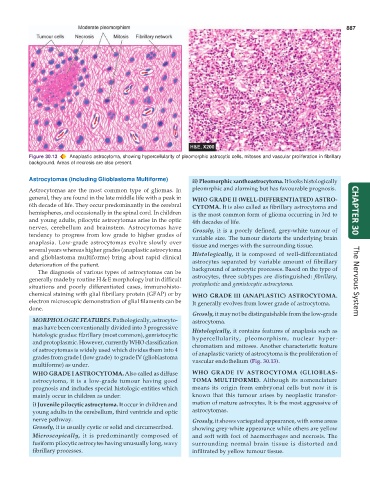
           Figure 30.13  Anaplastic astrocytoma, showing hypercellularity of pleomorphic astrocytic cells, mitoses and vascular proliferation in fibrillary
           background. Areas of necrosis are also present.

           Astrocytomas (including Glioblastoma Multiforme)      ii) Pleomorphic xanthoastrocytoma. It looks histologically
           Astrocytomas are the most common type of gliomas. In  pleomrphic and alarming but has favourable prognosis.
           general, they are found in the late middle life with a peak in  WHO GRADE II (WELL-DIFFERENTIATED) ASTRO-
           6th decade of life. They occur predominantly in the cerebral  CYTOMA. It is also called as fibrillary astrocytoma and
           hemispheres, and occasionally in the spinal cord. In children  is the most common form of glioma occurring in 3rd to  CHAPTER 30
           and young adults, pilocytic astrocytomas arise in the optic  4th decades of life.
           nerves, cerebellum and brainstem. Astrocytomas have   Grossly, it is a poorly defined, grey-white tumour of
           tendency to progress from low grade to higher grades of  variable size. The tumour distorts the underlying brain
           anaplasia. Low-grade astrocytomas evolve slowly over  tissue and merges with the surrounding tissue.
           several years whereas higher grades (anaplastic astrocytoma
           and glioblastoma multiforme) bring about rapid clinical  Histologically,  it is composed of well-differentiated
           deterioration of the patient.                         astrocytes separated by variable amount of fibrillary
              The diagnosis of various types of astrocytomas can be  background of astrocytic processes. Based on the type of
           generally made by routine H & E morphology but in difficult  astrocytes, three subtypes are distinguished:  fibrillary,  The Nervous System
           situations and poorly differentiated cases, immunohisto-  protoplastic and gemistocytic astrocytoma.
           chemical staining with glial fibrillary protein (GFAP) or by  WHO GRADE III (ANAPLASTIC) ASTROCYTOMA.
           electron microscopic demonstration of glial filaments can be  It generally evolves from lower grade of astrocytoma.
           done.
                                                                 Grossly, it may not be distinguishable from the low-grade
            MORPHOLOGIC FEATURES. Pathologically, astrocyto-     astrocytoma.
            mas have been conventionally divided into 3 progressive  Histologically, it contains features of anaplasia such as
            histologic grades: fibrillary (most common), gemistocytic  hypercellularity, pleomorphism, nuclear hyper-
            and protoplasmic. However, currently WHO classification  chromatism and mitoses. Another characteristic feature
            of astrocytomas is widely used which divides them into 4  of anaplastic variety of astrocytoma is the proliferation of
            grades from grade I (low grade)  to grade IV (glioblastoma  vascular endothelium (Fig. 30.13).
            multiforme) as under.
            WHO GRADE I ASTROCYTOMA. Also called as diffuse      WHO GRADE IV ASTROCYTOMA (GLIOBLAS-
            astrocytoma, it is a low-grade tumour having good    TOMA MULTIFORME).  Although its nomenclature
            prognosis and includes special histologic entities which  means its origin from embryonal cells but now it is
            mainly occur in children as under:                   known that this tumour arises by neoplastic transfor-
            i) Juvenile pilocytic astrocytoma. It occur in children and  mation of mature astrocytes. It is the most aggressive of
            young adults in the cerebellum, third ventricle and optic  astrocytomas.
            nerve pathway.                                       Grossly, it shows variegated appearance, with some areas
            Grossly, it is usually cystic or solid and circumscribed.  showing grey-white appearance while others are yellow
            Microscopically, it is predominantly composed of     and soft with foci of haemorrhages and necrosis. The
            fusiform pilocytic astrocytes having unusually long, wavy  surrounding normal brain tissue is distorted and
            fibrillary processes.                                infiltrated by yellow tumour tissue.

