


Page 907 - Textbook of Pathology, 6th Edition
P. 907
891


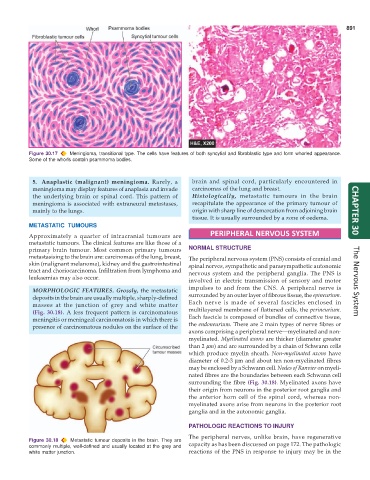
           Figure 30.17  Meningioma, transitional type. The cells have features of both syncytial and fibroblastic type and form whorled appearance.
           Some of the whorls contain psammoma bodies.


            5. Anaplastic (malignant) meningioma. Rarely, a      brain and spinal cord, particularly encountered in
            meningioma may display features of anaplasia and invade  carcinomas of the lung and breast.
            the underlying brain or spinal cord. This pattern of  Histologically, metastatic tumours in the brain
            meningioma is associated with extraneural metastases,  recapitulate the appearance of the primary tumour of
            mainly to the lungs.                                 origin with sharp line of demarcation from adjoining brain  CHAPTER 30
                                                                 tissue. It is usually surrounded by a zone of oedema.
           METASTATIC  TUMOURS
           Approximately a quarter of intracranial tumours are         PERIPHERAL NERVOUS SYSTEM
           metastatic tumours. The clinical features are like those of a
           primary brain tumour. Most common primary tumours   NORMAL STRUCTURE
           metastasising to the brain are: carcinomas of the lung, breast,  The peripheral nervous system (PNS) consists of cranial and
           skin (malignant melanoma), kidney and the gastrointestinal  spinal nerves, sympathetic and parasympathetic autonomic
           tract and choriocarcinoma. Infiltration from lymphoma and  nervous system and the peripheral ganglia. The PNS is
           leukaemias may also occur.
                                                               involved in electric transmission of sensory and motor  The Nervous System
            MORPHOLOGIC FEATURES. Grossly, the metastatic      impulses to and from the CNS. A peripheral nerve is
            deposits in the brain are usually multiple, sharply-defined  surrounded by an outer layer of fibrous tissue, the epineurium.
            masses at the junction of grey and white matter    Each nerve is made of several fascicles enclosed in
            (Fig. 30.18). A less frequent pattern is carcinomatous  multilayered membrane of flattened cells, the perineurium.
            meningitis or meningeal carcinomatosis in which there is  Each fascicle is composed of bundles of connective tissue,
            presence of carcinomatous nodules on the surface of the  the endoneurium. There are 2 main types of nerve fibres or
                                                               axons comprising a peripheral nerve—myelinated and non-
                                                               myelinated. Myelinated axons are thicker (diameter greater
                                                               than 2 μm) and are surrounded by a chain of Schwann cells
                                                               which produce myelin sheath. Non-myelinated axons have
                                                               diameter of 0.2-3 μm and about ten non-myelinated fibres
                                                               may be enclosed by a Schwann cell. Nodes of Ranvier on myeli-
                                                               nated fibres are the boundaries between each Schwann cell
                                                               surrounding the fibre (Fig. 30.18). Myelinated axons have
                                                               their origin from neurons in the posterior root ganglia and
                                                               the anterior horn cell of the spinal cord, whereas non-
                                                               myelinated axons arise from neurons in the posterior root
                                                               ganglia and in the autonomic ganglia.

                                                               PATHOLOGIC REACTIONS TO INJURY
                                                               The peripheral nerves, unlike brain, have regenerative
           Figure 30.18  Metastatic tumour deposits in the brain. They are  capacity as has been discussed on page 172. The pathologic
           commonly multiple, well-defined and usually located at the grey and
           white matter junction.                              reactions of the PNS in response to injury may be in the

