


Page 906 - Textbook of Pathology, 6th Edition
P. 906
890


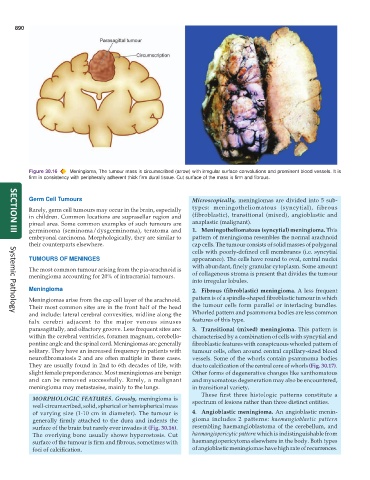
           Figure 30.16  Meningioma, The tumour mass is circumscribed (arrow) with irregular surface convolutions and prominent blood vessels. It is
           firm in consistency with peripherally adherent thick firm dural tissue. Cut surface of the mass is firm and fibrous.


           Germ Cell Tumours                                     Microscopically, meningiomas are divided into 5 sub-
           Rarely, germ cell tumours may occur in the brain, especially  types: meningotheliomatous (syncytial), fibrous
           in children. Common locations are suprasellar region and  (fibroblastic), transitional (mixed), angioblastic and
           pineal area. Some common examples of such tumours are  anaplastic (malignant).
           germinoma (seminoma/dysgerminoma), teratoma and       1. Meningotheliomatous (syncytial) meningioma. This
     SECTION III
           embryonal carcinoma. Morphologically, they are similar to  pattern of meningioma resembles the normal arachnoid
           their counterparts elsewhere.                         cap cells. The tumour consists of solid masses of polygonal
                                                                 cells with poorly-defined cell membranes (i.e. syncytial
           TUMOURS OF MENINGES                                   appearance). The cells have round to oval, central nuclei
                                                                 with abundant, finely granular cytoplasm. Some amount
           The most common tumour arising from the pia-arachnoid is
           meningioma accounting for 20% of intracranial tumours.  of collagenous stroma is present that divides the tumour
                                                                 into irregular lobules.
           Meningioma                                            2. Fibrous (fibroblastic) meningioma. A less frequent
           Meningiomas arise from the cap cell layer of the arachnoid.  pattern is of a spindle-shaped fibroblastic tumour in which
           Their most common sites are in the front half of the head  the tumour cells form parallel or interlacing bundles.
           and include: lateral cerebral convexities, midline along the  Whorled pattern and psammoma bodies are less common
     Systemic Pathology
           falx cerebri adjacent to the major venous sinuses     features of this type.
           parasagittally, and olfactory groove. Less frequent sites are:  3. Transitional (mixed) meningioma. This pattern is
           within the cerebral ventricles, foramen magnum, cerebello-  characterised by a combination of cells with syncytial and
           pontine angle and the spinal cord. Meningiomas are generally  fibroblastic features with conspicuous whorled pattern of
           solitary. They have an increased frequency in patients with  tumour cells, often around central capillary-sized blood
           neurofibromatosis 2 and are often multiple in these cases.  vessels. Some of the whorls contain psammoma bodies
           They are usually found in 2nd to 6th decades of life, with  due to calcification of the central core of whorls (Fig. 30.17).
           slight female preponderance. Most meningiomas are benign  Other forms of degenerative changes like xanthomatous
           and can be removed successfully. Rarely, a malignant  and myxomatous degeneration may also be encountered,
           meningioma may metastasise, mainly to the lungs.      in transitional variety.
                                                                    These first three histologic patterns constitute a
            MORPHOLOGIC FEATURES. Grossly, meningioma is         spectrum of lesions rather than three distinct entities.
            well-circumscribed, solid, spherical or hemispherical mass
            of varying size (1-10 cm in diameter). The tumour is  4. Angioblastic meningioma. An angioblastic menin-
            generally firmly attached to the dura and indents the  gioma includes 2 patterns:  haemangioblastic pattern
            surface of the brain but rarely ever invades it (Fig. 30.16).  resembling haemangioblastoma of the cerebellum, and
            The overlying bone usually shows hyperostosis. Cut   haemangiopericytic pattern which is indistinguishable from
            surface of the tumour is firm and fibrous, sometimes with  haemangiopericytoma elsewhere in the body. Both types
            foci of calcification.                               of angioblastic meningiomas have high rate of recurrences.

