


Page 100 - 9780077418427.pdf
P. 100
/Users/user-f465/Desktop
          tiL12214_ch03_061-084.indd Page Sec3:77  9/1/10  9:34 PM user-f465
          tiL12214_ch03_061-084.indd Page Sec3:77  9/1/10  9:34 PM user-f465                                            /Users/user-f465/Desktop


                           Water from a reservoir is conducted through large pipes   the most reliable and dependable of several energy sources.
                       called penstocks to a powerhouse, where it is directed against   Petroleum, coal, and hydropower are also used as energy sources
                       turbine blades that turn a shaft on an electric generator. A   for electric power production. The electric utility companies are
                       rough approximation of the power that can be extracted from   concerned that petroleum and natural gas are becoming increas-
                       the falling water can be made by multiplying the depth of the   ingly expensive, and there are questions about long-term supplies.
                         water (in feet) by the amount of water flowing (in cubic feet per     Hydropower has limited potential for growth, and solar energy is
                         second), then dividing by 10. The result is roughly equal to the   prohibitively expensive today. Utility companies see two major en-
                        horsepower.                                            ergy sources that are available for growth: coal and nuclear. There
                                                                               are problems and advantages to each, but the utility companies feel
                                                                               they must use coal and nuclear power until the new technologies,
                       NUCLEAR
                                                                               such as solar power, are economically feasible.
                       Nuclear power plants use nuclear energy to produce electricity.
                       Energy is released as the nuclei of uranium and plutonium at-
                       oms split, or undergo a nuclear reaction called fission and form   CONSERVING ENERGY
                                                                               Conservation is not a way of generating energy, but it is a way
                                                                               of reducing the need for additional energy consumption and
                                                                               saves money for the consumer. Some conservation technologies
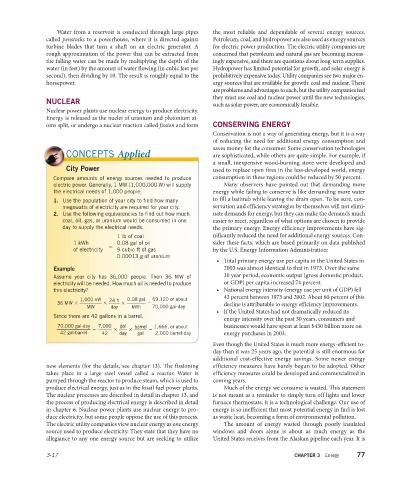
                              CONCEPTS Applied                                 are sophisticated, while others are quite simple. For example, if
                                                                               a small, inexpensive wood-burning stove were developed and
                              City Power                                       used to replace open fires in the less-developed world, energy
                          Compare amounts of energy sources needed to produce   consumption in these regions could be reduced by 50 percent.
                            electric power. Generally, 1 MW (1,000,000 W) will supply   Many observers have pointed out that demanding more
                          the electrical needs of 1,000 people.                energy while failing to conserve is like demanding more water
                          1.  Use the population of your city to find how many   to fill a bathtub while leaving the drain open. To be sure, con-
                             megawatts of electricity are required for your city.  servation and efficiency strategies by themselves will not elimi-
                          2.  Use the following equivalencies to find out how much   nate demands for energy, but they can make the demands much
                             coal, oil, gas, or uranium would be consumed in one   easier to meet, regardless of what options are chosen to provide
                             day to supply the electrical needs.               the primary energy. Energy efficiency improvements have sig-
                                               1 lb of coal                    nificantly reduced the need for additional energy sources. Con-
                                1 kWh       =   0.08 gal of oil                sider these facts, which are based primarily on data published
                                of electricity     9 cubic ft of gas           by the U.S. Energy Information Administration:
                                               0.00013 g of uranium
                                                                                •  Total primary energy use per capita in the United States in
                          Example                                                 2003 was almost identical to that in 1973. Over the same
                          Assume your city has 36,000 people. Then 36 MW of       30 year period, economic output (gross domestic product,
                          electricity will be needed. How much oil is needed to produce   or GDP) per capita increased 74 percent.
                          this electricity?                                     •  National energy intensity (energy use per unit of GDP) fell
                                                                                  43 percent between 1973 and 2002. About 60 percent of this
                                                  0.08 gal
                                   1,000 kW
                                   _        _     _        69,120 or about
                                            24 h


                                           ×
                           36 MW ×               ×        =                       decline is attributable to energy efficiency improvements.
                                     MW      day    kWh    70,000 gal∙day

                                                                                •  If the United States had not dramatically reduced its
                          Since there are 42 gallons in a barrel,
                                                                                  energy intensity over the past 30 years, consumers and
                                                gal
                           __            _      _    _     1,666, or about        businesses would have spent at least $430 billion more on
                                         7,000
                           70,000 gal∙day
                                                     barrel
                                              ×

                                       =


                                                              ×        =


                            42 gal∙barrel  42   day   gal   2,000 barrel∙day      energy purchases in 2003.

                                                                               Even though the United States is much more energy-efficient to-
                                                                               day than it was 25 years ago, the potential is still enormous for
                                                                               additional cost-effective energy savings. Some newer energy
                       new elements (for the details, see chapter 13). The  fissioning   efficiency measures have barely begun to be adopted. Other
                       takes place in a large steel vessel called a  reactor. Water is   efficiency measures could be developed and commercialized in
                       pumped through the reactor to produce steam, which is used to   coming years.
                       produce electrical energy, just as in the fossil fuel power plants.   Much of the energy we consume is wasted. This statement
                       The nuclear processes are described in detail in chapter 13, and   is not meant as a reminder to simply turn off lights and lower
                       the process of producing electrical energy is described in detail   furnace thermostats; it is a technological challenge. Our use of
                       in chapter 6. Nuclear power plants use nuclear energy to pro-  energy is so inefficient that most potential energy in fuel is lost
                       duce electricity, but some people oppose the use of this process.   as waste heat, becoming a form of environmental pollution.
                       The electric utility companies view nuclear energy as one energy   The amount of energy wasted through poorly insulated
                       source used to produce electricity. They state that they have no   windows and doors alone is about as much energy as the
                       allegiance to any one energy source but are seeking to utilize   United States receives from the Alaskan pipeline each year. It is
                       3-17                                                                               CHAPTER 3  Energy   77

