


Page 97 - 9780077418427.pdf
P. 97
/Users/user-f465/Desktop
          tiL12214_ch03_061-084.indd Page Sec3:74  9/1/10  9:34 PM user-f465
          tiL12214_ch03_061-084.indd Page Sec3:74  9/1/10  9:34 PM user-f465                                            /Users/user-f465/Desktop


                   ENERGY CONSERVATION                                    individual to another, energy flow from one  object to another
                   Energy can be transferred from one object to another, and it can   requires a mode of transfer. In energy matters, the mode of
                   be converted from one form to another form. If you make a de-  transfer is working or heating. Any time you see working or
                   tailed accounting of all forms of energy before and after a transfer   heating occurring, you know that an energy transfer is taking
                   or conversion, the total energy will be constant. Consider your bi-  place. The next time you see heating, think about what energy
                   cycle coasting along over level ground when you apply the brakes.   form is being converted to what new energy form. (The final
                   What happened to the kinetic mechanical energy of the bicycle? It   form is usually radiant energy.) Heating is the topic of  chapter 4,
                   went into heating the rim and brakes of your bicycle, then eventu-  where you will consider the role of heat in energy matters.
                   ally radiated to space as infrared radiation. All radiant energy that
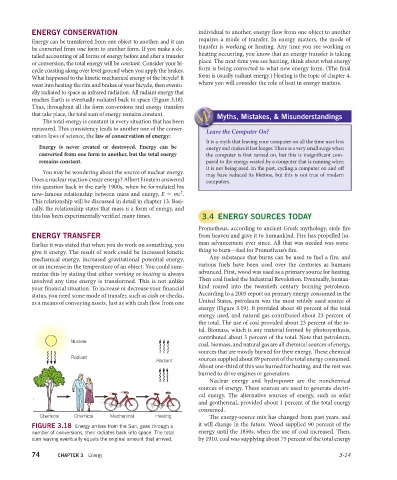
                   reaches Earth is eventually radiated back to space (Figure 3.18).
                   Thus, throughout all the form conversions and energy transfers
                   that take place, the total sum of energy remains constant.   Myths, Mistakes, & Misunderstandings
                      The total energy is constant in every situation that has been
                   measured. This consistency leads to another one of the conser-  Leave the Computer  On?
                   vation laws of science, the law of conservation of energy:
                                                                            It is a myth that leaving your computer on all the time uses less
                     Energy is never created or destroyed. Energy can be    energy and makes it last longer. There is a very small surge when
                     converted from one form to another, but the total energy   the computer is first turned on, but this is insignificant com-
                     remains constant.                                      pared to the energy wasted by a computer that is running when
                                                                            it is not being used. In the past, cycling a computer on and off
                      You may be wondering about the source of nuclear energy.   may have reduced its lifetime, but this is not true of modern
                   Does a nuclear reaction create energy? Albert Einstein answered   computers.
                   this question back in the early 1900s, when he formulated his
                                                                    2
                   now-famous relationship between mass and energy, E = mc .
                   This relationship will be discussed in detail in chapter 13. Basi-
                   cally, the relationship states that mass is a form of energy, and
                   this has been experimentally verified many times.       3.4  ENERGY SOURCES TODAY
                                                                          Prometheus, according to ancient Greek mythology, stole fire
                   ENERGY TRANSFER                                        from heaven and gave it to humankind. Fire has propelled hu-
                   Earlier it was stated that when you do work on something, you   man advancement ever since. All that was needed was some-
                   give it energy. The result of work could be increased kinetic   thing to burn—fuel for Prometheus’s fire.
                   mechanical energy, increased gravitational potential energy,   Any substance that burns can be used to fuel a fire, and
                   or an increase in the temperature of an object. You could sum-  various fuels have been used over the centuries as humans
                   marize this by stating that either working or heating is always     advanced. First, wood was used as a primary source for heating.
                   involved any time energy is transformed. This is not unlike   Then coal fueled the Industrial Revolution. Eventually, human-
                   your financial situation. To increase or decrease your financial   kind roared into the twentieth century burning pe troleum.
                   status, you need some mode of transfer, such as cash or checks,     According to a 2005 report on primary energy  consumed in the
                   as a means of conveying assets. Just as with cash flow from one   United States, petroleum was the most widely used source of
                                                                          energy (Figure 3.19). It provided about 40 percent of the total
                                                                          energy used, and natural gas contributed about 23 percent of
                                                                          the total. The use of coal provided about 23 percent of the to-
                                                                          tal. Biomass, which is any material formed by photosynthesis,
                                                                          contributed about 3 percent of the total. Note that petroleum,
                                Nuclear
                                                                          coal, biomass, and natural gas are all chemical sources of energy,
                                                                          sources that are mostly burned for their  energy. These chemical
                                Radiant
                                                            Radiant       sources supplied about 89 percent of the total energy consumed.
                                                                          About one-third of this was burned for heating, and the rest was
                                                                          burned to drive engines or generators.
                                                                             Nuclear energy and hydropower are the nonchemical
                                                                          sources of energy. These sources are used to generate electri-
                                                                          cal energy. The alternative sources of energy, such as solar
                                                                          and geo thermal, provided about 1 percent of the total energy
                                                                           consumed.
                     Chemical    Chemical    Mechanical     Heating          The energy-source mix has changed from past years, and
                                                                          it will change in the future. Wood supplied 90 percent of the
                   FIGURE 3.18  Energy arrives from the Sun, goes through a
                   number of conversions, then radiates back into space. The total   energy until the 1850s, when the use of coal increased. Then,
                   sum leaving eventually equals the original amount that arrived.  by 1910, coal was supplying about 75 percent of the total energy

                   74      CHAPTER 3 Energy                                                                             3-14

