


Page 96 - 9780077418427.pdf
P. 96
/Users/user-f465/Desktop
tiL12214_ch03_061-084.indd Page Sec3:73 9/1/10 9:34 PM user-f465
tiL12214_ch03_061-084.indd Page Sec3:73 9/1/10 9:34 PM user-f465 /Users/user-f465/Desktop
EXAMPLE 3.10
What is the kinetic energy of a 1.0 kg book just before it hits the floor
after a 1.0 m fall? (Answer: 9.7 J)
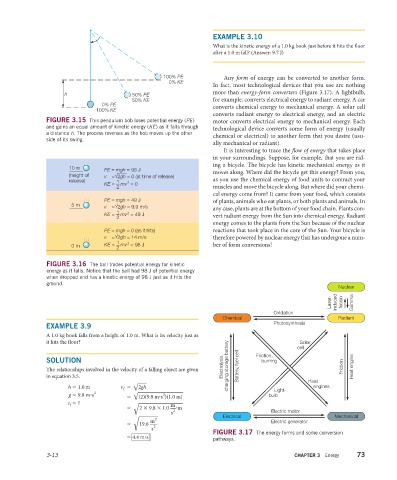
100% PE Any form of energy can be converted to another form.
0% KE
In fact, most technological devices that you use are nothing
h 50% PE more than energy-form converters (Figure 3.17). A lightbulb,
50% KE for example, converts electrical energy to radiant energy. A car
0% PE converts chemical energy to mechanical energy. A solar cell
100% KE
converts radiant energy to electrical energy, and an electric
FIGURE 3.15 This pendulum bob loses potential energy (PE) motor converts electrical energy to mechanical energy. Each
and gains an equal amount of kinetic energy (KE) as it falls through technological device converts some form of energy (usually
a distance h. The process reverses as the bob moves up the other chemical or electrical) to another form that you desire (usu-
side of its swing.
ally mechanical or radiant).
It is interesting to trace the flow of energy that takes place
in your surroundings. Suppose, for example, that you are rid-
ing a bicycle. The bicycle has kinetic mechanical energy as it
10 m PE = mgh = 98 J
√
(height of v = 2gh = 0 (at time of release) moves along. Where did the bicycle get this energy? From you,
release) 1 as you use the chemical energy of food units to contract your
2
KE = mv = 0
2 muscles and move the bicycle along. But where did your chemi-
cal energy come from? It came from your food, which consists
PE = mgh = 49 J of plants, animals who eat plants, or both plants and animals. In
5 m v = 2gh = 9.9 m/s any case, plants are at the bottom of your food chain. Plants con-
√
1
2
KE = mv = 49 J vert radiant energy from the Sun into chemical energy. Radiant
2
energy comes to the plants from the Sun because of the nuclear
PE = mgh = 0 (as it hits) reactions that took place in the core of the Sun. Your bicycle is
√
v = 2gh = 14 m/s therefore powered by nuclear energy that has undergone a num-
1 2
0 m KE = mv = 98 J ber of form conversions!
2
FIGURE 3.16 The ball trades potential energy for kinetic
energy as it falls. Notice that the ball had 98 J of potential energy
when dropped and has a kinetic energy of 98 J just as it hits the
ground.
Nuclear
Laser- induced fusion Gamma
Oxidation
Chemical Radiant
Photosynthesis
EXAMPLE 3.9
A 1.0 kg book falls from a height of 1.0 m. What is its velocity just as
it hits the floor? Solar
cell
SOLUTION Friction,
burning
The relationships involved in the velocity of a falling object are given Electrolysis, charging storage battery Battery , fuel cell Friction Heat engine
in equation 3.5. Heat
h = 1.0 m v = √ 2gh engines
f Light-
2
2
g = 9.8 m∙ s = √ (2)(9.8 m∙ s )(1.0 m) bulb
v = ? m _
f
= 2 × 9.8 × 1.0 ⋅m
2
s Electric motor
Electrical Mechanical
2 Electric generator
_
m
= 19.6
2
s
FIGURE 3.17 The energy forms and some conversion
= 4.4 m∙s pathways.
3-13 CHAPTER 3 Energy 73

