


Page 99 - 9780077418427.pdf
P. 99
/Users/user-f465/Desktop
          tiL12214_ch03_061-084.indd Page Sec3:76  9/1/10  9:34 PM user-f465
          tiL12214_ch03_061-084.indd Page Sec3:76  9/1/10  9:34 PM user-f465                                            /Users/user-f465/Desktop


                           People Behind the Science


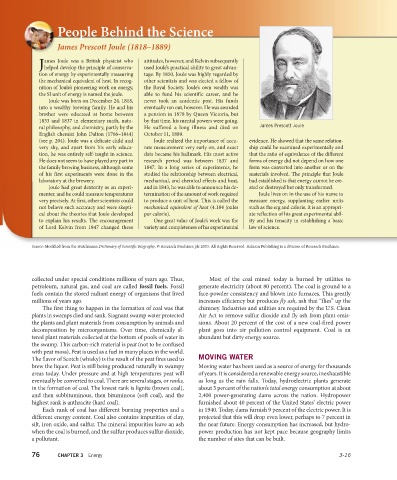
                           James Prescott Joule (1818–1889)

                       ames Joule was a British physicist who   attitudes, however, and Kelvin subsequently
                     Jhelped develop the principle of conserva-  used Joule’s practical ability to great advan-
                     tion of energy by experimentally measuring   tage. By 1850, Joule was highly regarded by
                     the mechanical equivalent of heat. In recog-  other scientists and was elected a fellow of
                     nition of Joule’s pioneering work on energy,   the Royal Society. Joule’s own wealth was
                     the SI unit of energy is named the joule.  able to fund his scientific career, and he
                        Joule was born on December 24, 1818,   never took an academic post. His funds
                     into a wealthy brewing family. He and his   eventually ran out, however. He was awar ded
                     brother were educated at home between   a pension in 1878 by Queen Victoria, but
                     1833 and 1837 in elementary math, natu-  by that time, his mental powers were going.
                     ral philosophy, and chemistry, partly by the   He suffered a long illness and died on   James Prescott Joule
                     English chemist John Dalton (1766–1844)   October 11, 1889.
                     (see p. 204). Joule was a delicate child and   Joule realized the importance of accu-  evidence. He showed that the same relation-
                     very shy, and apart from his early educa-  rate measurement very early on, and exact   ship could be examined experimentally and
                     tion, he was entirely self-taught in science.   data became his hallmark. His most active   that the ratio of equivalence of the different
                     He does not seem to have played any part in   research period was between 1837 and   forms of energy did not depend on how one
                     the family brewing business, although some   1847. In a long series of experiments, he   form was converted into another or on the
                     of his first experiments were done in the   studied the relationship between electrical,   materials involved. The principle that Joule
                     laboratory at the brewery.         mechanical, and chemical effects and heat,   had established is that energy  cannot be cre-
                        Joule had great dexterity as an experi-  and in 1843, he was able to announce his de-  ated or destroyed but only transformed.
                     menter, and he could measure temperatures   termination of the amount of work required   Joule lives on in the use of his name to
                     very precisely. At first, other scientists could   to produce a unit of heat. This is called the   measure energy, supplanting earlier units
                     not believe such accuracy and were skepti-    mechanical equivalent of heat (4.184 joules   such as the erg and calorie. It is an appropri-
                     cal about the theories that Joule developed   per calorie).           ate reflection of his great experimental abil-
                     to explain his results. The encouragement   One great value of Joule’s work was the   ity and his tenacity in establishing a basic
                     of Lord Kelvin from 1847 changed these   variety and completeness of his experimental   law of science.


                   Source: Modified from the Hutchinson Dictionary of Scientific Biography. © Research Machines plc 2003. All Rights Reserved. Helicon Publishing is a division of Research  Machines.


                   collected under special conditions millions of years ago. Thus,   Most of the coal mined today is burned by utilities to
                   petroleum, natural gas, and coal are called fossil fuels. Fossil     generate electricity (about 80 percent). The coal is ground to a
                   fuels contain the stored radiant energy of organisms that lived   face-powder consistency and blown into furnaces. This greatly
                   millions of years ago.                                 increases efficiency but produces fl y ash, ash that “flies” up the
                      The first thing to happen in the formation of coal was that   chimney. Industries and utilities are required by the U.S. Clean
                   plants in swamps died and sank. Stagnant swamp water protected   Air Act to remove sulfur dioxide and fly ash from plant emis-
                   the plants and plant materials from consumption by animals and   sions. About 20 percent of the cost of a new coal-fired power
                   decomposition by microorganisms. Over time, chemically al-  plant goes into air pollution control equipment. Coal is an
                   tered plant materials collected at the bottom of pools of water in   abundant but dirty energy source.
                   the swamp. This carbon-rich material is peat (not to be confused
                   with peat moss). Peat is used as a fuel in many places in the world.
                   The flavor of Scotch (whisky) is the result of the peat fires used to   MOVING WATER
                   brew the liquor. Peat is still being produced naturally in swampy   Moving water has been used as a source of energy for thousands
                   areas today. Under pressure and at high temperatures peat will   of years. It is considered a renewable energy source,  inexhaustible
                   eventually be converted to coal. There are several stages, or ranks,   as long as the rain falls. Today, hydroelectric plants generate
                   in the formation of coal. The lowest rank is lignite (brown coal),   about 3 percent of the nation’s total energy consumption at about
                   and then subbituminous, then bituminous (soft coal), and the   2,400 power-generating dams across the nation. Hydropower
                   highest rank is anthracite (hard coal).                furnished about 40 percent of the United States’ electric power
                      Each rank of coal has different burning properties and a   in 1940. Today, dams furnish 9 percent of the electric power. It is
                   different energy content. Coal also contains impurities of clay,   projected that this will drop even lower,  perhaps to 7 percent in
                   silt, iron oxide, and sulfur. The mineral impurities leave an ash   the near future. Energy consumption has  increased, but hydro-
                   when the coal is burned, and the sulfur produces sulfur dioxide,   power production has not kept pace because geography limits
                   a pollutant.                                           the number of sites that can be built.

                   76      CHAPTER 3 Energy                                                                             3-16

