


Page 98 - 9780077418427.pdf
P. 98
/Users/user-f465/Desktop
          tiL12214_ch03_061-084.indd Page Sec3:75  9/1/10  9:34 PM user-f465
          tiL12214_ch03_061-084.indd Page Sec3:75  9/1/10  9:34 PM user-f465                                            /Users/user-f465/Desktop


                                                                                  Science and Society


                                                                                                Grow Your Own Fuel?
                              ave you heard of biodiesel? Biodie-     Why would we want to use vegetable oil   is used. People behind such a biodiesel-
                          Hsel is a vegetable-based oil that can   to run diesel engines? First, it is a sustain-  powered school bus complained that it
                          be used for fuel in diesel engines. It can be   able (or renewable) resource. It also reduces   smelled like fried  potatoes, making them
                          made from soy oils, canola oil, or even recy-  dependency on foreign oil as well as cuts   hungry.
                          cled deep-fryer oil from a fast-food restau-  the trade deficit. It runs smoother, produces      There is a website maintained by some
                          rant. Biodiesel can be blended with regular   less exhaust smoke, and reduces the health   biodiesel users where you can learn how to
                          diesel oil in any amount. Or it can be used   risks associated with petroleum diesel. The   produce your own biodiesel from algae. See
                          100 percent pure in diesel cars, trucks, and   only negative aspect seems to occur when   www.biodieselnow.com and search for the
                          buses, or as home heating oil.     recycled oil from fast-food restaurants   term algae.


                       needs. Next petroleum began making increased contributions   permits the accumulation of sediments that are exceptionally rich
                       to the energy supply. Now increased economic and environ-  in organic material. This could occur under special conditions in
                       mental constraints and a decreasing supply of petroleum are   a freshwater lake, or it could occur on shallow ocean basins. In
                       producing another supply shift. The present petroleum-based   either case, most of the organic material is from plankton—tiny
                       energy era is about to shift to a new energy era.       free-floating animals and plants such as algae. It is from such ac-
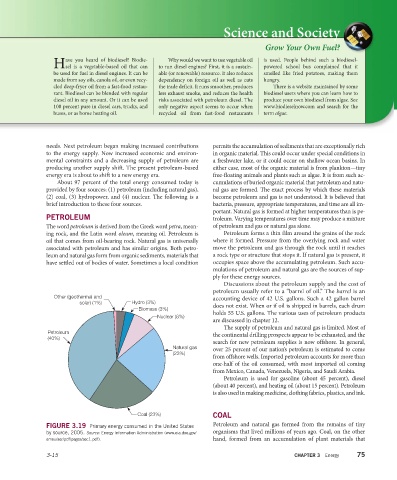
                           About 97 percent of the total energy consumed today is   cumulations of buried organic material that  petroleum and natu-
                       provided by four sources: (1) petroleum (including natural gas),   ral gas are formed. The exact process by which these materials
                       (2) coal, (3) hydropower, and (4) nuclear. The following is a   become petroleum and gas is not understood. It is believed that
                       brief introduction to these four sources.               bacteria, pressure, appropriate temperatures, and time are all im-
                                                                               portant. Natural gas is formed at higher temper atures than is pe-
                       PETROLEUM                                               troleum. Varying temperatures over time may produce a mixture
                       The word petroleum is derived from the Greek word petra, mean-  of petroleum and gas or natural gas alone.
                       ing rock, and the Latin word oleum, meaning oil. Petroleum is   Petroleum forms a thin film around the grains of the rock
                       oil that comes from oil-bearing rock. Natural gas is  universally   where it formed. Pressure from the overlying rock and water
                         associated with petroleum and has similar origins. Both petro-  move the petroleum and gas through the rock until it reaches
                       leum and natural gas form from organic sediments, materials that   a rock type or structure that stops it. If natural gas is present, it
                       have settled out of bodies of water. Sometimes a local condition   occupies space above the accumulating petroleum. Such accu-
                                                                               mulations of petroleum and natural gas are the sources of sup-
                                                                               ply for these energy sources.
                                                                                  Discussions about the petroleum supply and the cost of
                                                                               petroleum usually refer to a “barrel of oil.” The barrel is an
                          Other (geothermal and                                accounting device of 42 U.S. gallons. Such a 42 gallon barrel
                                   solar) (1%)      Hydro (3%)                 does not exist. When or if oil is shipped in barrels, each drum
                                                      Biomass (3%)
                                                                               holds 55 U.S. gallons. The various uses of petroleum products
                                                            Nuclear (8%)
                                                                               are discussed in chapter 12.
                                                                                  The supply of petroleum and natural gas is limited. Most of
                        Petroleum                                              the continental drilling prospects appear to be exhausted, and the
                        (40%)
                                                                               search for new petroleum supplies is now offshore. In general,
                                                                 Natural gas   over 25 percent of our nation’s petroleum is estimated to come
                                                                 (23%)
                                                                               from offshore wells. Imported petroleum accounts for more than
                                                                               one-half of the oil consumed, with most imported oil coming
                                                                               from Mexico, Canada, Venezuela, Nigeria, and Saudi Arabia.
                                                                                  Petroleum is used for gasoline (about 45 percent), diesel
                                                                               (about 40 percent), and heating oil (about 15 percent). Petroleum
                                                                               is also used in making medicine, clothing fabrics, plastics, and ink.


                                                      Coal (23%)               COAL
                                                                               Petroleum and natural gas formed from the remains of tiny
                       FIGURE 3.19  Primary energy consumed in the United States
                                                                               organisms that lived millions of years ago. Coal, on the other
                       by source, 2005. Source: Energy Information Administration (www.eia.doe.gov/
                        emeu/aer/pdf/pages/sec1.pdf).                          hand, formed from an accumulation of plant materials that
                       3-15                                                                               CHAPTER 3  Energy   75

