


Page 95 - 9780077418427.pdf
P. 95
/Users/user-f465/Desktop
          tiL12214_ch03_061-084.indd Page Sec3:72  9/1/10  9:34 PM user-f465
          tiL12214_ch03_061-084.indd Page Sec3:72  9/1/10  9:34 PM user-f465                                            /Users/user-f465/Desktop


                                22                  High energy
                              10                                          by a string or wire from a support. If the bob is moved to
                                                                          one side and then released, it will swing back and forth in
                              10 21
                                     Gamma rays                           an arc. At the moment that the bob reaches the top of its swing,
                              10 20                                       it stops for an instant, then begins another swing. At the instant
                                19                                        of stopping, the bob has 100 percent potential  energy and no
                              10
                                                                          kinetic energy. As the bob starts back down through the swing, it
                              10 18    X rays
                                                                          is gaining kinetic energy and losing  potential energy. At the instant
                              10 17                                       the bob is at the bottom of the swing, it has 100 percent kinetic en-
                                      Ultraviolet                         ergy and no potential  energy. As the bob now climbs through the
                                16
                              10
                                                  Visible                 other half of the arc, it is gaining potential energy and losing kinetic
                              10 15                                       energy until it again reaches an  instantaneous stop at the top, and
                              10 14                                       the process starts over. The kinetic energy of the bob at the bottom
                             Frequency, Hz  10 12  Infrared               (Figure 3.15). Disregarding friction, the sum of the potential ene rgy
                                                                          of the arc is equal to the potential energy it had at the top of the arc
                                13
                                                                          and the kinetic energy remains constant throughout the swing.
                              10
                                                                             The potential energy lost during a fall equals the kinetic
                                11
                              10
                                                                            energy gained (Figure 3.16). In other words,
                                10    Microwave
                              10
                                                                                               PE      =  KE    gained
                                                                                               lost
                              10 9
                                                                          Substituting the values from equations 3.3 and 3.4,
                              10 8     FM, TV
                                                                                                    1 _  2
                                7


                              10                                                              mgh =      mv
                                                                                                    2
                              10 6
                                     AM broadcast                         Canceling the m and solving for v f ,
                              10 5                  Low energy
                                                                                                 v     =     √
                                                                                                     2

                                                                                                      gh
                                4                                                               f
                              10
                                      Long radio                                                                  equation 3.5
                              10 3     waves
                                                                             Equation 3.5 tells you the final speed of a falling object  after
                                                                          its potential energy is converted to kinetic energy. This assumes,
                   FIGURE 3.13  The frequency spectrum of electromagnetic   however, that the object is in free fall, since the effect of air resis-
                   waves. The amount of radiant energy carried by these waves
                                                                          tance is ignored. Note that the m’s cancel, showing again that the
                   increases with frequency. Note that visible light occupies only a
                   small part of the complete spectrum.                   mass of an object has no effect on its final speed.
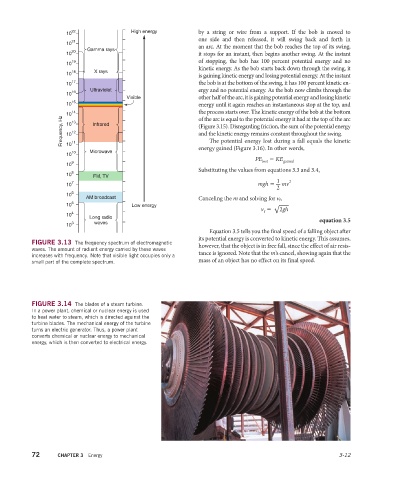
                   FIGURE 3.14  The blades of a steam turbine.
                   In a power plant, chemical or nuclear energy is used
                   to heat water to steam, which is directed against the
                   turbine blades. The mechanical energy of the turbine
                   turns an electric generator. Thus, a power plant
                   converts chemical or nuclear energy to mechanical
                   energy, which is then converted to electrical energy.


                   72      CHAPTER 3 Energy                                                                             3-12

