


Page 110 - 9780077418427.pdf
P. 110
/Users/user-f465/Desktop
          tiL12214_ch04_085-114.indd Page 87  9/1/10  9:37 PM user-f465
          tiL12214_ch04_085-114.indd Page 87  9/1/10  9:37 PM user-f465                                                 /Users/user-f465/Desktop


                                                                               smallest particle of a compound or a gaseous element that
                                                                               can exist and still retain the characteristic properties of that
                                                                               substance.


                                                                               MOLECULES INTERACT
                                                                               Some molecules of solids and liquids interact, strongly
                                                                               attracting and clinging to one another. When this attractive
                                                                               force is between the same kind of molecules, it is called cohe-
                                                                               sion. It is a stronger cohesion that makes solids and liquids

                                                                               different from gases, and without cohesion, all matter would
                                                                               be in the form of gases. Sometimes one kind of molecule
                                                                               attracts and clings to a different kind of molecule. Th e attrac-

                                                                               tive force between unlike molecules is called adhesion. Water
                                                                               wets your skin because the adhesion of water molecules and
                                                                               skin is stronger than the cohesion of water molecules. Some
                                                                               substances, such as glue, have a strong force of adhesion when
                                                                               they harden from a liquid state, and they are called adhesives.


                       FIGURE 4.1  Heat and modern technology are inseparable.
                        These glowing steel slabs, at over 1,100°C (about 2,000°F), are   PHASES OF MATTER
                        cut by an automatic flame torch. The slab caster converts 300  tons   Three phases of matter are common on Earth under condi-

                        of molten steel into slabs in about 45 minutes. The slabs are
                        converted to sheet steel for use in the automotive, appliance, and   tions of ordinary temperature and pressure. Th ese phases—or
                        building industries.                                   forms of existence—are solid, liquid, and gas. Each of these has

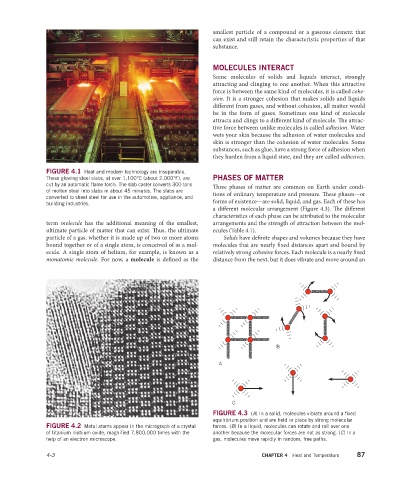
                                                                               a  different molecular arrangement (Figure 4.3). Th e  diff erent
                                                                               characteristics of each phase can be attributed to the molecular
                       term  molecule has the additional meaning of the smallest,   arrangements and the strength of attraction between the mol-

                         ultimate particle of matter that can exist. Thus, the ultimate   ecules (Table 4.1).
                       particle of a gas, whether it is made up of two or more atoms   Solids have defi nite shapes and volumes because they have
                       bound together or of a single atom, is conceived of as a mol-  molecules that are nearly fixed distances apart and bound by

                       ecule. A single atom of helium, for example, is known as a   relatively strong cohesive forces. Each molecule is a nearly fi xed
                       monatomic molecule. For now, a molecule is defined as the   distance from the next, but it does vibrate and move around an


                                                                                                    B

                                                                                 A


                                                                                     C

                                                                               FIGURE 4.3  (A) In a solid, molecules vibrate around a fixed
                                                                               equilibrium position and are held in place by strong molecular
                       FIGURE 4.2  Metal atoms appear in the micrograph of a crystal   forces. (B) In a liquid, molecules can rotate and roll over one
                        of titanium niobium oxide, magnified 7,800,000 times with the   another because the molecular forces are not as strong. (C) In a
                        help of an electron microscope.                        gas, molecules move rapidly in random, free paths.

                       4-3                                                                     CHAPTER 4  Heat and Temperature   87

